On October 26, Donald Trump was all smiles when leaders of Thailand and Cambodia signed a ceasefire deal, putting an end to the hostilities that saw the deaths of 43 people and displacement of 300,000 others.
However, six weeks later, a war-like situation has erupted once again between the two Asian nations, with Thailand launching airstrikes against Cambodia. The military action by Bangkok, it said, was retaliation after Phnom Penh reportedly launched an attack, killing a Thai soldier.
What is exactly happening? How did the Thailand-Cambodia conflict went from Trump-backed ceasefire to airstrikes? Here’s what we found out.
Fresh violence erupts along Thailand-Cambodia border
On early Monday morning,
Thailand launched airstrikes on neighbouring Cambodia, with Thai army spokesperson Major General Winthai Suvaree saying that the action targeted Cambodian military infrastructure, and were retaliation for an attack earlier on Monday that killed a Thai soldier.
Thailand’s military authorities confirmed that it had destroyed a cable car that led up to the ancient temple Prasant ta Krabei (Kwai in Thai). The army said that around 9:20 am local time, the cable car which led to Hill 350 and the Cambodian concrete stairs were destroyed by an air attack.
In a separate statement, the Royal Thai Air Force (RTAF) said “Cambodia had mobilised heavy weaponry, repositioned combat units and prepared fire-support elements – activities that could escalate military operations and pose a threat to the Thai border area.”
Thailand’s Prime Minister in televised remarks said that military operations would be carried out as necessary to defend the country and protect public safety. “Thailand has never wished for violence. I’d like to reiterate that Thailand has never initiated a fight or an invasion, but will never tolerate a violation of its sovereignty,” he said.
According to Thailand, Phnom Penh escalated the situation with a skirmish along the contested border. This resulted in one soldier being killed and eight being wounded.
However, Cambodia has a different version of events. The country’s ministry of national defence blamed Thailand for the latest escalation, saying Thai forces had launched attacks on Cambodian troops on Monday morning, adding that Cambodia had not retaliated, despite “provocative actions for many days”.
Three Cambodian civilians were seriously injured in Oddar Meanchey province according to Met Measpheakdey, the province’s deputy governor.
Cambodian Defence Ministry spokesperson Maly Socheata noted that shortly before 7 am on Monday, Thailand moved to the use of tanks, toxic gas and artillery fire — attacking Cambodian forces and civilian locations.
Additionally, Cambodia’s former prime minister Hun Sen urged his country’s forces to exercise restraint, saying Thailand was trying to “pull us into retaliation”. “The red line for responding has already been set. I urge commanders at all levels to educate all officers and soldiers accordingly,” Hun Sen said in a Facebook post.
According to a BBC news report, Thailand’s strikes even hit a Cambodian casino complex. But Thai army spokesperson Winthai Suvaree said that it was a “command centre for drones”.
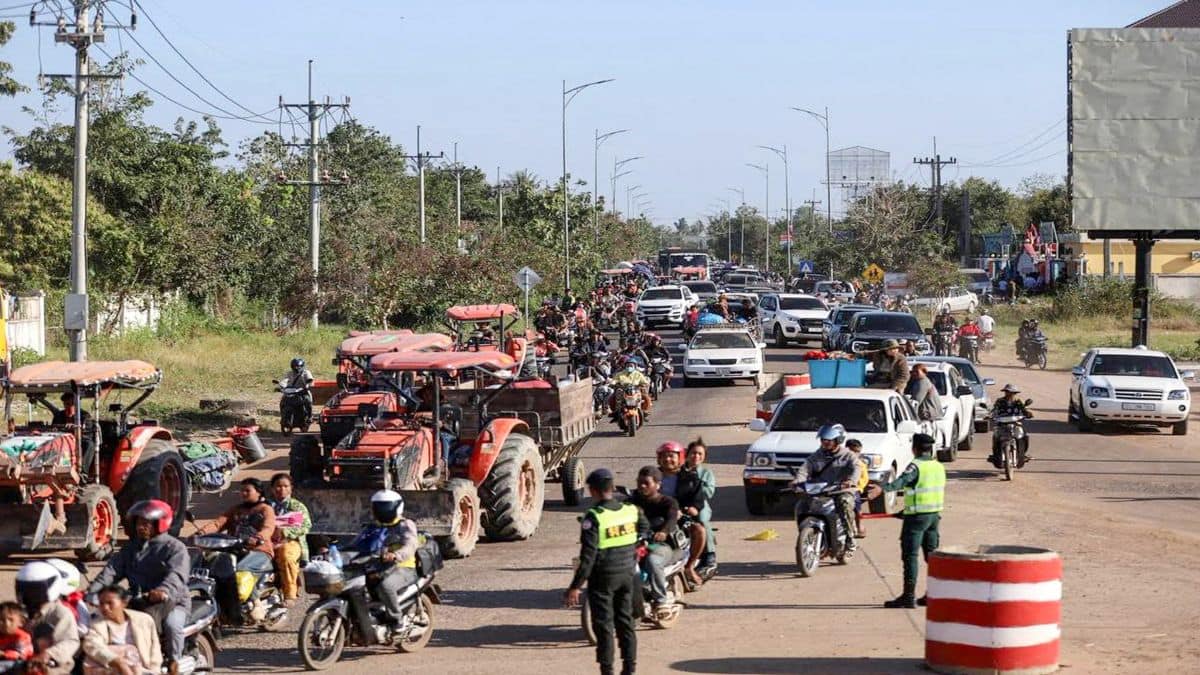
And as a result of the fresh violence, thousands of civilians on both sides of the border between Thailand and Cambodia began evacuating their houses. As farmer Pannarat Woratham told AFP, “The village head told us to evacuate, and given what happened in July, I complied immediately.”
Notably, this is the second time the 59-year-old had fled since late July when open combat was waged with fighter jets, missile strikes and ground troops, killing both civilians and soldiers. “Of course many of us thought the conflict was finally over. It shouldn’t have happened again like this.”
A truce in tatters
The violence between Thailand and Cambodia comes after the two sides signed an expanded ceasefire declaration in Kuala Lumpur in late October in a ceremony witnessed by US President Donald Trump and Malaysian Prime Minister Anwar Ibrahim.
This ceasefire came in the aftermath of a
five-day conflict in July in which 43 people died, and countless others on both sides of the border were displaced. The July hostilities even saw Thailand deploying F-16 fighter jets, whereas Cambodia fired batteries of Russia-made BM-21 rockets and artillery shells.
But the October peace was tenuous to say the least. Within less than a fortnight of signing, the agreement between Thailand and Cambodia began fraying. On November 11, Thailand said it was
halting the implementation of the ceasefire pact with Cambodia a day after a landmine blast maimed a Thai soldier. Cambodia’s defence ministry, at the time, denied having laid new landmines.
And a day later, at least one person was killed in Cambodia as the neighbours accused each other of opening fire.
Thailand-Cambodia enmity that goes back centuries
While the fresh violence between Thailand and Cambodia is worrying, the two countries have been at odds for years, namely over their shared border — an area that has never been fully demarcated.
The boundary was originally mapped in 1907 by the French during the colonial rule of Cambodia, based on an agreement to follow the region’s natural watershed line.
In 2008, however, tensions flared when Cambodia moved to designate the 11th-century
Preah Vihear temple as a UNESCO World Heritage site, sparking deadly exchanges between the two militaries. The violence then peaked in 2011 with a sustained week-long artillery battle.
At that time, Cambodia turned to the International Court of Justice, asking it to clarify a 1962 ruling that had granted the temple to Cambodia and to issue measures to prevent further military confrontations. In 2013, the ICJ reaffirmed that the entire temple promontory lay within Cambodian territory.
As The Diplomat explains in one of its reports, for many Cambodians and Thais, the prospect of territorial loss, however insignificant, is closely connected to deep-seated feelings of national loss and humiliation.
The new flare-up has caused alarm bells for many in the region. Malaysian Prime Minister Anwar Ibrahim who helped broker the original ceasefire, even urged both nations to exercise restraint. “We urge both sides to exercise maximum restraint, maintain open channels of communication and make full use of the mechanisms in place,” he said in a post online.
With inputs from agencies
End of Article
Leave a Reply