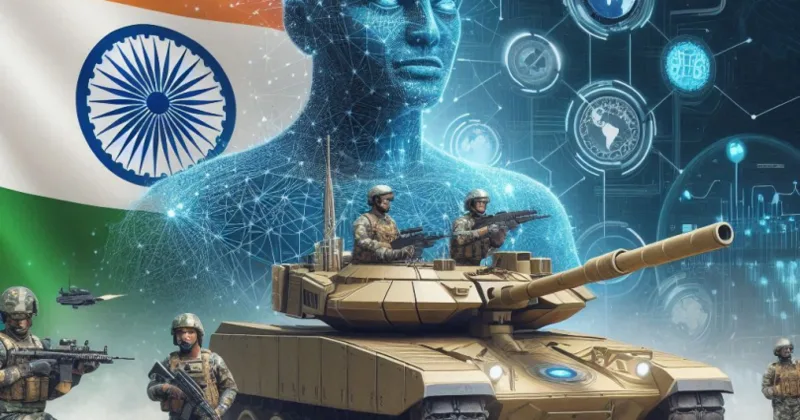
When Defence Minister Rajnath Singh unveiled a suite of cutting-edge digital initiatives at Chanakya Dialogue 2025, it was not simply the release of a few technological platforms. It signified Bharat’s confident civilisational leap into a future where military preparedness is measured not merely by firepower, but by information dominance, cognitive speed and technological self-reliance.
The Indian Army’s push from boots to bytes is deeply strategic. It signals that Bharat is no longer content with being a consumer of global military technologies; It is now determined to shape its own defence architecture—deeply rooted in dharma, strategic autonomy and the logic of a civilisation-state reclaiming its rightful place.
AI Handbook: Ethical warfare rooted in dharma
The launch of the AI Handbook for military leaders marks an important ideological and intellectual shift within the Armed Forces. While global powers debate the morality of autonomous weapons, Bharat is clear that technology must remain subordinate to human wisdom. This is not merely policy—it is a civilisational imperative.
The Handbook equips senior commanders with:
- Conceptual clarity on AI and machine learning,
- Distinctions between genuine AI and simple automation,
- Ethical frameworks rooted in manavta and humanitarian law,
- Guidance for human–machine teaming
- Awareness of vulnerabilities such as data bias and algorithmic brittleness.
It is not technology alone that defines military strength; it is the ability to integrate it with dharma. The Indian Army’s approach reflects this timeless principle.
Project EKAM: Bharat’s quest for AI sovereignty
Project EKAM is a landmark move towards strategic technological autonomy. Built indigenously under iDEX ADITI 2.0, EKAM is designed as a secure, military-grade AI backbone that integrates seamlessly into the Army Data Network. Its suite of tools is deeply rooted in the Army’s operational needs.
In particular:
Jigyasa acts as a GPT-style intelligence engine with secure Retrieval-Augmented Generation, enabling commanders to query military doctrines and operational data.
Darpan functions as a powerful document analyser, extracting key insights from large dossiers.
Manthan operates as a document-specific reasoning agent capable of interpreting complex files.
Saar provides concise summaries of lengthy operational inputs.
Anuvadak ensures flawless translation across multiple Indian languages, reflecting Bharat’s linguistic diversity.
Lipik generates clear correspondence drafts for staff work, while Rachna creates structured presentations.
Lekhak converts speech to text with military accuracy and Vaachak converts text to speech for quick briefings.
Together, these tools shrink decision timelines, simplify staff procedures, strengthen multilingual communication and elevate operational efficiency across commands.
The upcoming development of Bharat’s first indigenous military LLM under EKAM is a strategic milestone—ensuring that data sovereignty, security protocols and doctrinal nuance remain firmly under national control.
Digitalisation 3.0: A blueprint for the Army’s technological ecosystem
The release of Digitalisation 3.0 – From Boots to Bytes provides a 360-degree view of the Army’s digital evolution. With 100 applications documented, the volume showcases both the scale and sincerity of the Army’s modernisation drive.
Part I: Digital Sena – From Boots to Bytes(40 Initiatives)
This section captures automation and digitisation initiatives improving logistics, communication, training and transparency. From tethered UAV-based jammers to IGIST tri-service GIS systems and advanced online training tools, the Army is moving decisively away from legacy processes.
Part II: Towards an AI-Ready Army (60 Solutions)
This section demonstrates the rapid spread of AI across operational, intelligence and surveillance systems. Solutions like the AI-infused eSitrep, Talwar small-language model and EKAM’s full suite illustrate how the Army is preparing to dominate information-centric warfare.
Digitalisation 3.0 is not just a technological roadmap; it is a statement of civilisational intent. It strengthens Atmanirbhar Bharat, reduces dependence on foreign technologies and drives indigenous innovation to the forefront of military preparedness.
PRAKSHEPAN: Predicting the battlefield of the Himalayas
The unveiling of PRAKSHEPAN, developed by DGIS with multiple national scientific agencies, marks a major step in terrain-specific operational readiness. With AI and ML models trained on two decades of data, PRAKSHEPAN predicts:
- Landslides and avalanches in Sikkim,
- Floods in Arunachal Pradesh and Assam,
- Long-term climate-linked risks.
Its GIS-based interface assists in route planning, logistics safety, disaster mitigation and infrastructure protection—essential for the Himalayan theatre where nature itself is a constant adversary. PRAKSHEPAN reflects the synergy of Indian science and soldiering, ensuring that both troops and border communities receive timely warnings and support.
The OODA Loop: The new frontline of the Himalayan conflict
The Army’s digital push is fundamentally about winning the OODA Loop—Observe, Orient, Decide, Act.
Conceptualised by strategist Col. John Boyd, the OODA Loop defines the speed at which a military formation can:
- Observe the environment
- Orient itself by analysing data
- Decide the best course of action
- Act before the adversary reacts
In the Himalayas—where China invests heavily in AI surveillance, autonomous systems and electronic warfare—the side that cycles through OODA faster gains a decisive tactical edge.
Digitalisation 3.0, EKAM and PRAKSHEPAN collectively compress the OODA cycle for Bharat, enabling:
- quicker intelligence processing
- faster operational responses
- more accurate predictions of environmental hazards
- superior situational awareness
The objective is clear: Bharat must outthink, out-decide and outmanoeuvre the adversary—especially in the mountains.
A Military modernising without losing its soul
The Indian Army’s digital renaissance is not an imitation of Western models. It is a uniquely Bhartiya project combining:
- Technological sharpness
- Ethical clarity
- Civilisational grounding
- Strategic autonomy
Rajnath Singh’s vision is unmistakable: Bharat must lead in the military paradigms of the 21st century, not follow. From the AI Handbook to EKAM, from Digitalisation 3.0 to PRAKSHEPAN, the Army is building a future-ready force that remains anchored in dharma while mastering the tools of modern warfare.
This is not just modernisation. It is Bharat-centric modernisation of military technology—aligning the Army’s digital architecture with Bharat’s civilisational ethos. In this lies the Indian military’s greatest long-term strategic advantage.
Leave a Reply