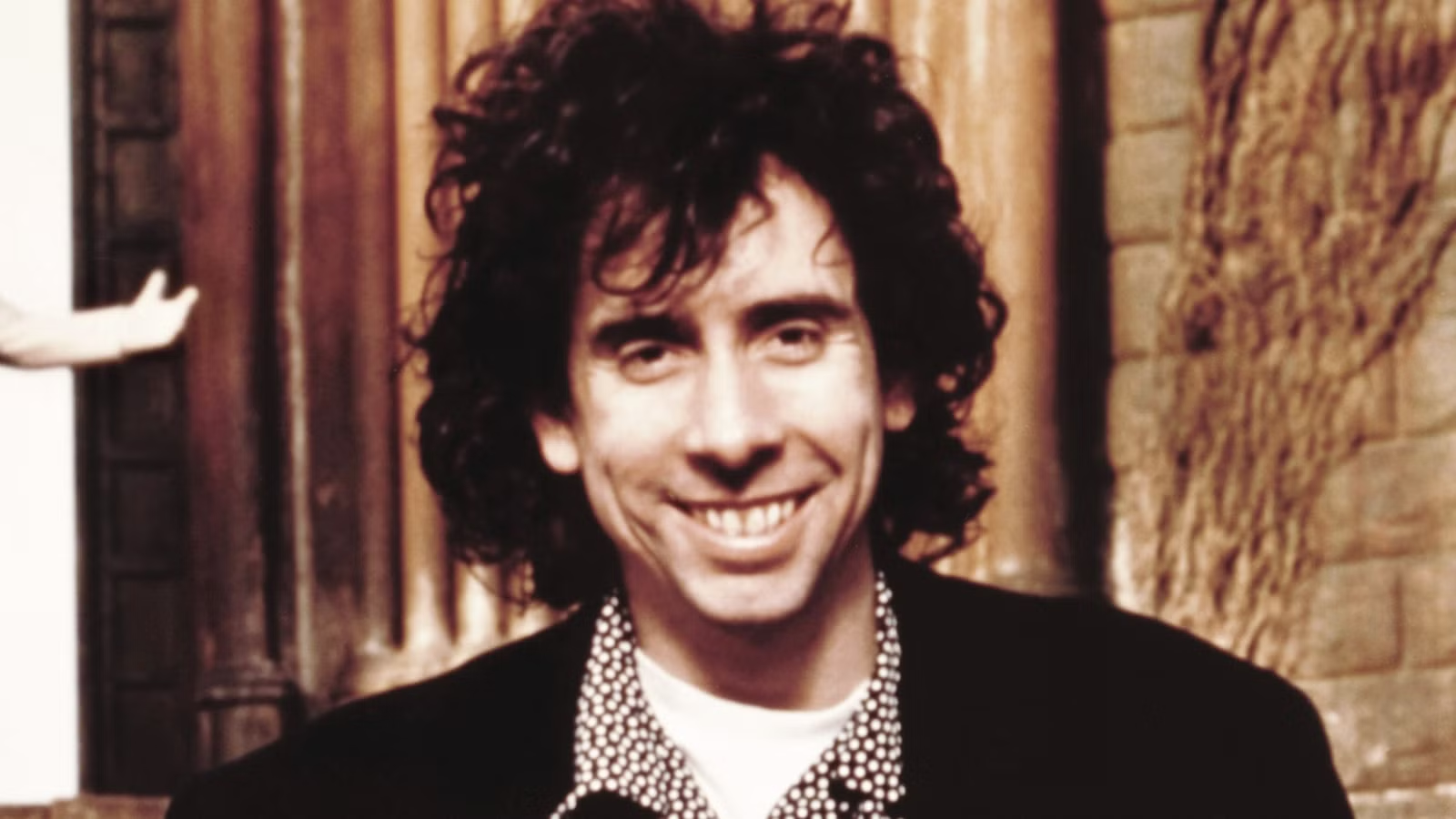
There aren’t many directors with a more immediately identifiable visual sensibility than Tim Burton. More than any other modern filmmaker, his work is likely responsible for each new generation of kids understanding the idea of movies with authorial signature. This is all the more impressive considering Burton isn’t writing his own material. Beyond working off other people’s screenplays, most of his movies adapt characters from an eclectic variety of sources: comic books, Broadway musicals, trading cards, real life eccentrics, the mind of Paul Ruebens. Outside of his animated movies, only one of his films sprang from a character created, which makes Edward Scissorhands stand as his most revealing film, even 35 years after its release on Dec. 7, 1990.
Edward began life as a sketch Burton made as a teenager, reflecting the alienation he felt growing up feeling like an outsider in sunny Burbank, California. He hired Caroline Thompson (who would also go on to write The Nightmare Before Christmas and Corpse Bride) to write a full story for the character, pitched halfway between fairy tale and satire. Edward (Johnny Depp) lives in a crumbling gothic mansion that looms over a pastel-colored suburban enclave. He’s the creation of a strange scientist (played briefly by Burton’s hero Vincent Price), a Dr. Frankenstein figure who dies before he can replace a clatter of sharp and lengthy blades with actual hands and fingers. Edward is introduced to suburban living when a chipper Avon-selling neighbor (Dianne Wiest) comes calling. Soon he’s living with her family, and quietly falling in love with daughter Kim (Winona Ryder).

The broad arc of Edward’s story — brought into a world he doesn’t understand by a mad scientist, accidentally causing hurt, pursued by angry townsfolk — recalls the most famous adaptation of Frankenstein, the James Whale version from 1931. Burton’s sympathy for Edward, however, is more in line with Guillermo del Toro’s recent Frankenstein, only Burton takes it even further. While both Whale and del Toro’s versions of the creature are sympathetic creations, they’re also unavoidably (if understandably) monstrous. It may not be their fault, but their whole existence is owed to a transgression against the natural boundaries of life. This is made apparent by the use of a damaged “criminal” brain in the Whale movie, and the cursed nature of the creature’s inability to die in del Toro’s.
Edward, however, isn’t framed as the product of graverobbing, resurrection, or anything else that seems overtly unholy. He’s treated more like an automaton, all the better to serve as a point of contrast with the technically human but tragically conformist suburbanites he encounters. The scientist who created him may have been misguided on some level, but the fact that he affixed blades to this poor creature as a substitute for hands is, if anything, a gentle parody of the good-enough approach to brain transplants used in the old Frankenstein movies.

In Burton’s hands, Edward Scissorhands is a movie heavily inspired by Universal monster movies where the central monster isn’t one — he’s only made to feel that way. As sympathetic as Frankenstein’s Monster, the Wolf Man, and the Creature from the Black Lagoon can be, they do ultimately have a more animalistic, killer side to them. Edward, however, remains the gentlest character in the movie. Any transgression he commits, he does so because of human influence; while Frankenstein’s Monster fails to understand how to interact with a little girl and accidentally kills her while playing a game, Edward’s wrongdoing is only ever actively provoked. When he’s physically attacked at the end of the movie, he doesn’t defend his own life, and he only springs into action when bully Jim (Anthony Michael Hall) hits Kim. The movie’s sole death is caused by Jim quite literally bringing a gun to a knife fight.
Given the lengths Burton goes to keep Edward’s scissorhands relatively clean, it would be easy enough to accuse the director of neutering horror tropes for something both cuddlier and more self-pitying. The two qualities even dovetail with Edward’s inability to properly touch Kim: “Hold me,” she implores a young man who looks a lot like then-hearthrob Johnny Depp. “I can’t,” he responds with as much teenage angst as a soft-spoken mechanical man can muster. He’s not beating the mall-goth charges, in other words. And it is true that as macabre he can be, Burton rarely makes flat-out horror films. Most of his forays into the genre involve comedy or a dark-hued form of cuteness; several of them are expressly for children. Even the genuine R-rated horror Sleepy Hollow has a fairy-tale beauty enveloping its story of beheadings and bloodletting.

Yet by making his version of Frankenstein almost entirely free of scary (non-human) monsters, Burton expresses a child’s connection to fictional creatures with uncommon purity. Many children are drawn to movie monsters, whether of the Universal, kaiju, or Pokémon varieties; Burton’s movies externalize a fascination that could be considered, as Lydia Deetz says, “strange and unusual.” Del Toro isn’t shy about the fact that he considers Dr. Frankenstein, not his creation, to be the real monster, but his Creature still kills, albeit largely in self-defense. Burton doesn’t just tell his audience that it’s OK to gaze, with some horror, upon a monstrous figure, and eventually locate some empathy. He all but directly states that Edward is good, and most of the other humans are, well, maybe not bad, but misguided at best, cruel bigots at worst, and easily led dopes in the middle.
For a horror movie, it’s soft. For a self-portrait, it’s ultimately pretty glorifying — and that’s without even getting into the strangeness of watching Johnny Depp, who currently seems proudest of his most louche weaknesses as a person, play such an innocent soul. But in the realms of both bittersweet fairy tales and suburban satire, Burton maintains the courage of his convictions. Over the past 35 years, some of Burton’s fans have yearned for a return to his kind of heartfelt original story, rather than his steady stream of reimaginings and de facto remakes. Yet part of what’s special about Edward Scissorhands is the ironically fleeting nature of a character who might well live forever in his castle. Burton has put his heart into plenty of other films — some even better than this one. But how many times can a director make a heart from scratch?
Leave a Reply