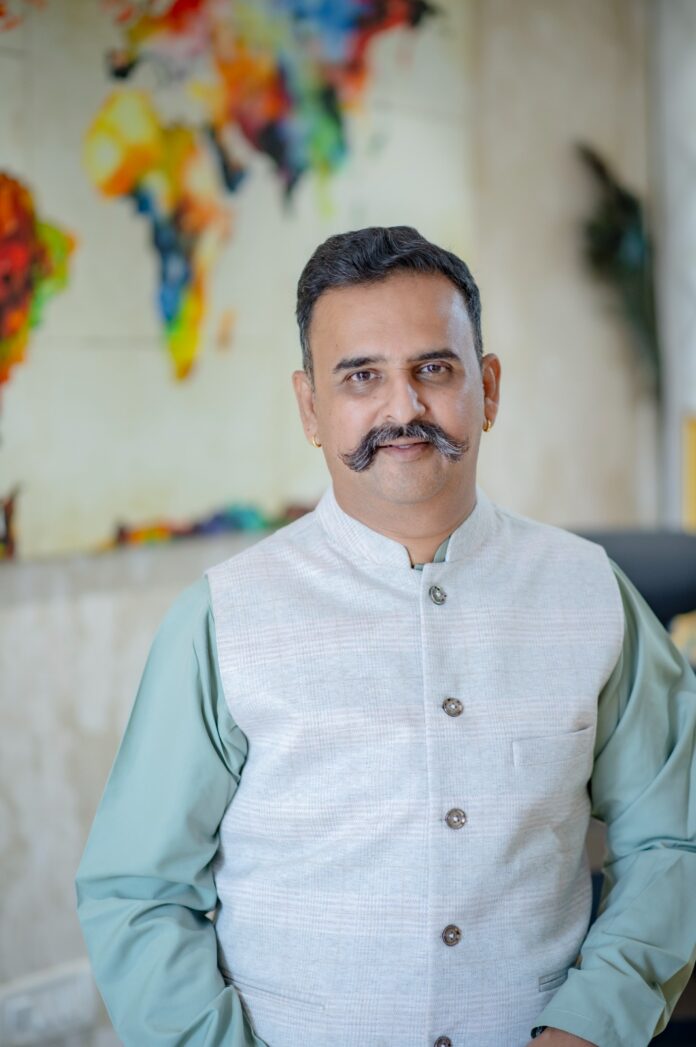

At a time when India’s spiritual resurgence is becoming a defining cultural force, Giresh Vasudev Kulkarni stands at the intersection of heritage, technology, and global faith tourism. As the founder of Temple Connect and ITCX — International Temples Convention & EXPO, Kulkarni has emerged as one of the country’s most influential voices shaping how temples are managed, experienced, and preserved in the 21st century.
His inclusion in ET Panache IP Festivals & Concerts A-List 2025—unveiled at the prestigious Shows of India Conclave 2025—signals the growing national and international recognition of his work. But what truly sets him apart is the scale of his vision: transforming temple towns into organised spiritual ecosystems, introducing corporate-grade efficiency into pilgrimage circuits, and reimagining faith as an immersive, emotionally resonant experience for a new generation.
In this conversation, Kulkarni opens up about the spiritual shift among young Indians, the future of temple-town weddings, the rise of experiential bhakti, and how ITCX is setting new benchmarks for sustainability, sanctity, and technological stewardship across thousands of temples.

1. Temple-town weddings are suddenly the new trend for Gen Z and Millennials. From your ICWF talk, what do you feel is truly drawing young couples there — the spiritual vibe, the cultural nostalgia, or just the desire for something more meaningful than a typical big-fat wedding?
At the ICWF (International Congress for Wedding Futures), I emphasised that this trend is driven by a desire for substance. For Gen Z and Millennials, the “Big Fat Indian Wedding” often feels transactional or purely performative. It is not just nostalgia; it is the spiritual vibe and the “blessing” factor. Young couples want their union to be rooted in something eternal. A wedding in a temple town like Varanasi, Puri, or Tirupati offers a “sacred backdrop” that a hotel ballroom simply cannot replicate. This aligns with the Prime Minister’s “Wed in India” call. We are seeing a move from ostentation to authenticity.

2. You often describe spirituality as becoming “experiential.” How does your nine-city India Tour with Kirtan artist Radhika Das help reinterpret bhakti, music, and meditation for a young audience seeking authenticity and emotional depth?
My partnership with Radhika Das for the nine-city India Tour is deeply strategic. We are witnessing a “Digital Detox” movement where youth are seeking experiential spirituality. Radhika Das makes Kirtan accessible, removing the rigidity often associated with religious gatherings and replacing it with joy, music, and community.
For a young audience battling anxiety and digital fatigue, this tour is not about “preaching”; it is about participation. By positioning Bhakti as a tool for mental wellness and emotional connection, we are helping them find silence in the noise.

3. Your partnership with Trip To Temples for the Kailash Mansarovar Yatra signals a new direction for structured spiritual tourism. What systemic gaps were you aiming to solve, and how will this partnership alter the pilgrimage ecosystem in the long run?
The pilgrimage ecosystem has historically suffered from three major gaps: Information Asymmetry, Lack of standardisation, and Accessibility Barriers. Our partnership with Trip To Temples aims to fix this. We are introducing corporate-level management to spiritual journeys. We are moving from “unorganised travel” to “Managed Spiritual Tourism.” By standardising logistics, we ensure the pilgrim focuses on Shiva, not survival. This sets a benchmark for safety and comfort that other operators will eventually have to match.

4. Temple tourism is expanding rapidly, but so is the fear of over-commercialisation. How does ITCX mediate between tradition-bearers, tourism stakeholders, and tech innovators to ensure the ethical development of temple ecosystems?
The fear of over-commercialisation is valid. At ITCX, we act as the bridge between Tradition-Bearers (Priests/Trustees) and Innovators (Tech/Tourism boards). We advocate that commercialisation should fund conservation. Revenue from tourism must go back into the temple’s infrastructure (sanitation, queue complexes, community kitchens). We bring tech companies to the table not to replace rituals, but to manage the crowd. For example, we push for AI-based crowd management so that the sanctity of the Garbha Griha (sanctum sanctorum) is not violated by chaos. We ensure that “modernisation” stops at the door of the ritual; inside, tradition rules supreme.

5. As a pioneering platform in temple management and sustainability, ITCX operates across thousands of temples with diverse needs. How do you define what ‘modernisation’ should look like while ensuring heritage, rituals, and sanctity remain untouched?
This is the core of my mission. Modernisation is for the facility, not the faith.
What Modernisation Looks Like: It looks like clean toilets, shoe-keeping management, digital donations (fintech), and organised queues. It looks like renewable energy is powering the temple lights and effective waste management for floral offerings.
What Remains Untouched: The Agama Shastras (scriptures defining temple worship), the rituals, the chants, and the role of the priest.
The ITCX Standard: We teach temples that being “modern” means being “efficient.” A devotee should not spend 4 hours in a queue fighting for air; they should spend that time in a state of devotion. Technology facilitates the Darshan; it does not replace the Deity.

6. With temple towns like Ayodhya, Ujjain, and Puri undergoing major transformation, what core elements—design, infrastructure, storytelling, or community engagement—do you believe are essential to shaping them into world-class spiritual destinations? And how does ITCX plan to lead this evolution in the next five years?
For these towns to become world-class spiritual destinations, the focus must shift from just “building temples” to “building ecosystems.”
- Infrastructure: Seamless last-mile connectivity and “airport-style” amenities (cleanliness, signage).
- Storytelling: Moving beyond dry history to immersive narratives (Sound & Light shows, AR/VR experiences) that engage the visitor.
- Community Engagement: The local flower seller and auto-driver are the first brand ambassadors. They must benefit economically from the tourism to be sustainable.
ITCX’s 5-year vision is to bring over as many temples as we can under a unified initiative to strengthen the economy in temples and Temple towns in every possible way. Our goal is to create a high-tech system for temple management, benchmarking them on hygiene, safety, and administration.

Giresh Vasudev Kulkarni’s work signals a pivotal shift in India’s spiritual ecosystem. By bringing structure to centuries-old practices and designing modern, sustainable temple experiences, he is setting a global benchmark for how faith-based tourism should evolve.
In the coming years, as temple towns reimagine themselves and spiritual tourism becomes more immersive, ITCX will remain at the forefront of this transformation—driven by Kulkarni’s unwavering belief that devotion deserves dignity, depth, and design.
Leave a Reply