
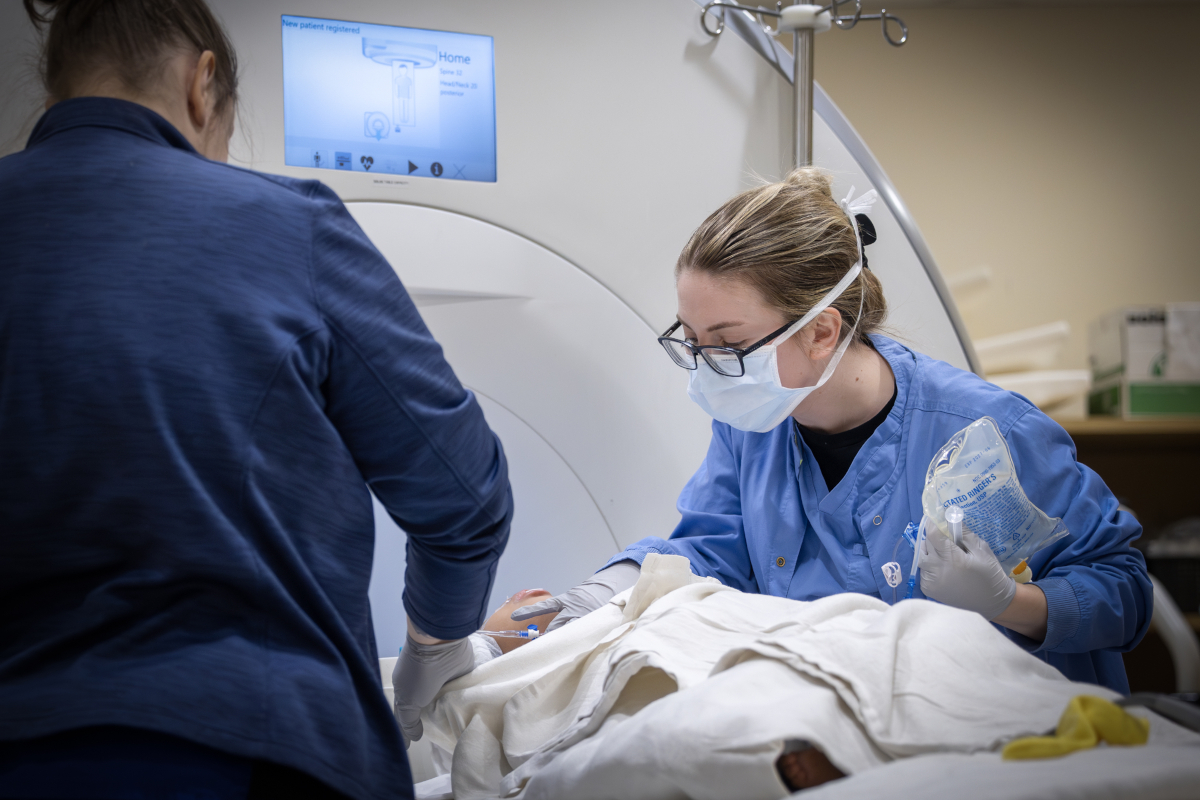
Two clinical team members at Penn State Health Milton S. Hershey Medical Center prepare a patient for an MRI with Deep Resolve technology, which uses deep learning to generate faster, sharper and clearer MRI images.
New innovation funded through Children’s Miracle Network enhances safety and comfort for pediatric and adult patients
Penn State Health is now using a cutting-edge imaging technology that significantly reduces the time patients spend under anesthesia during MRI scans – with especially meaningful benefits for children. Due to generous support from Children’s Miracle Network and the local community, Milton S. Hershey Medical Center has implemented Deep Resolve, an AI-powered image reconstruction software developed by Siemens Healthineers.
December 8, 2025
Deep Resolve uses deep learning to generate faster, sharper and clearer MRI images. By accelerating scan times, the technology helps minimize the duration of anesthesia – a critical improvement for pediatric patients, whose developing bodies are more sensitive to sedation.
“Reducing anesthesia time is a game-changer for children,” said Anita Krivenko, chief MRI technologist at Milton S. Hershey Medical Center. “It means less risk, less stress and a more comfortable experience for our youngest patients and their families.”
Since its installation in April, Deep Resolve has transformed the way MRI scans are performed at Penn State Health Golisano Children’s Hospital. Radiologists initially validated the software’s accuracy by comparing it to standard imaging protocols. The results were so promising that approximately 90% of pediatric MRI scans now rely solely on Deep Resolve – and families are already seeing the benefits.
On average, scan times are shortened by seven to 10 minutes per exam. For example, a knee MRI can now be completed in just seven minutes, while the duration of more complex scans – such as brain imaging – can be reduced by up to 70%. This not only shortens anesthesia time but also decreases the
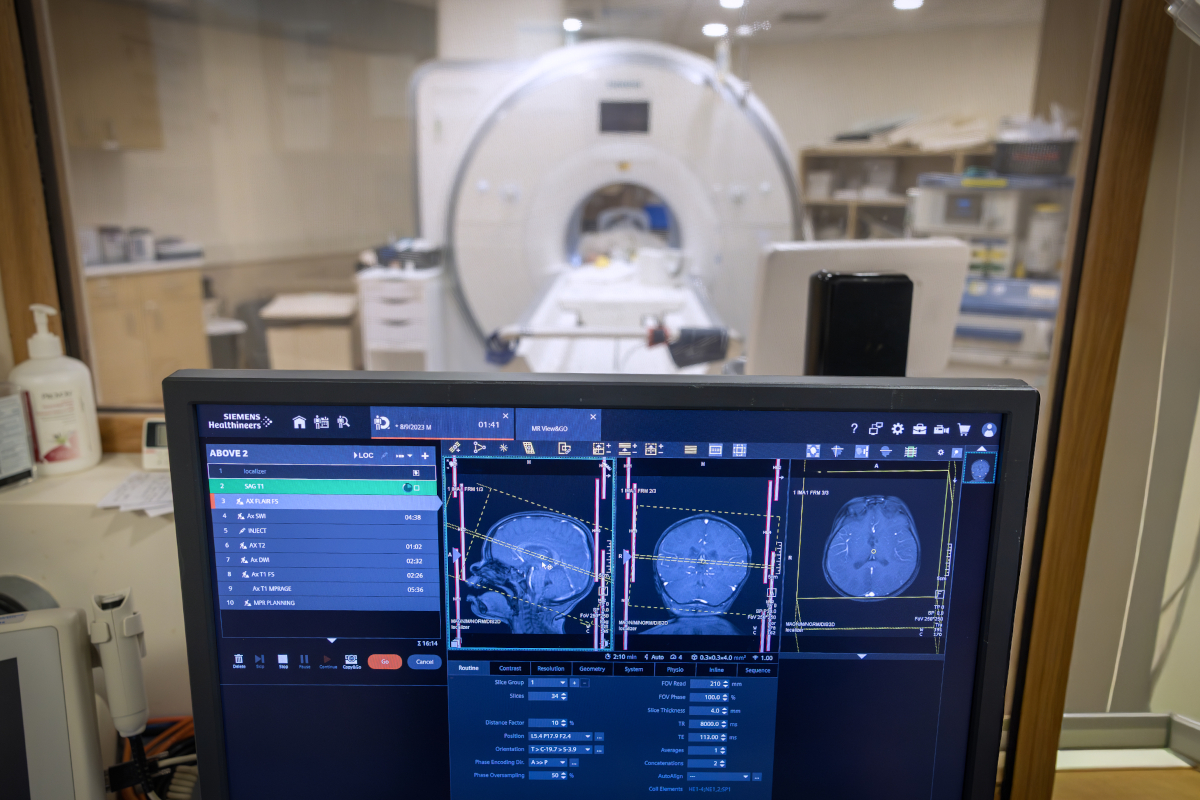
On average, scan times for MRIs performed with Deep Resolve technology are shortened by seven to 10 minutes per exam.
likelihood of repeat scans due to patient movement, which is especially helpful for children experiencing pain or anxiety.
In some cases, Deep Resolve has eliminated the need for anesthesia altogether. With support from the hospital’s Child Life team – which specializes in preparing and comforting children during medical procedures – many young patients can now complete their MRI scans while fully awake.
While the technology was introduced with a focus on pediatric care, Deep Resolve is also being used for adult patients at Milton S. Hershey Medical Center, improving comfort, reducing repeat scans and increasing access to care across all age groups. Faster imaging means more patients can be seen each day, helping streamline services and reduce wait times.
Penn State Health is rolling out Deep Resolve Technology across most of its MRI units. Eight scanners across the health system will soon feature this advanced technology.
Children’s Miracle Network provided funding for Deep Resolve. CMN supports life-saving equipment, essential patient programs and innovative research to improve care for children in the communities served by Penn State Health Golisano Children’s Hospital.
“We’re incredibly grateful to our donors and community partners,” said Katie Anderson, director of Children’s Miracle Network. “Their support allows us to bring state-of-the-art technology like Deep Resolve to our hospital, ensuring that children receive the safest, most advanced care possible – right here at home.”
The Children’s Hospital is the first hospital in central Pennsylvania to offer Deep Resolve technology.
To learn more about how donor support is helping transform care for children and families, visit www.cmnhershey.org.
If you’re having trouble accessing this content, or would like it in another format, please email Penn State Health Marketing & Communications.
Leave a Reply