An Increased Use of AI Tools Across Industries
According to Stanford’s 2025 AI Index report, a massive 78 percent of organizations are already using AI in at least one part of their work. That’s up from 55 percent in just one year.
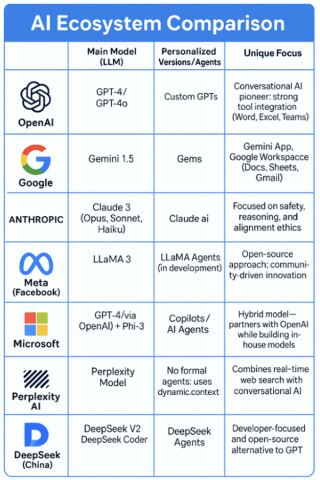
AI is advancing rapidly, and the large powerful, proprietary models. These “Large Language Models” are the “brains” behind tools like ChatGPT, Gemini, Claude, and more.
The chart provides a simple explanation of the major players, the models they’ve built, how they’re used, and what makes each one stand out.
What does this mean for students?
Recent research from top universities suggests that entry-level roles are already feeling the crunch of AI adoption. A Harvard University study tracking 62 million workers across 285,000 US firms found junior positions “shrinking at companies integrating AI” since 2023.
The researchers warn that AI is “eroding the ‘bottom rungs’ of career ladders” by automating many “intellectually mundane tasks” that junior employees typically handle.
A Stanford University analysis echoed this trend: workers aged 22–25 in AI-exposed fields experienced a 13 percent relative decline in employment, even as older colleagues saw gains in the same sectors. This suggests AI is starting to have a “significant and disproportionate impact on entry-level workers.”
Just as the research shows clear shifts in early-career roles, Professor Giancarlo Crocetti, D.P.S., at The Lesley H. and William L. Collins College of Professional Studies at St. John’s University and Director of the University’s AI Institute, warned that these trends may be symptoms of a much bigger problem. Companies are deploying AI so quickly that they may be restructuring their workforces without fully understanding the long-term effects.
“The real challenge isn’t just that AI is changing work, it’s that we’re deploying it faster than we can understand its implications,” says Dr. Crocetti. “Companies are making irreversible decisions about workforce structure based on projected efficiencies that may not materialize or that may create new, unforeseen problems. Students entering this market aren’t just facing a skills gap; they’re entering an environment of profound institutional uncertainty.”
Which entry-level jobs are being most impacted?
To gain more insight, we spoke with Bob Beaudet, St. John’s University’s Director of Employer Relations at The Peter J. Tobin College of Business, to better understand how these trends are playing out with employers interacting directly with graduates today.
“Anything repetitive, in any industry, is being affected,” says Mr. Beaudet. “In fields like accounting and certain data-heavy financial roles, we’re seeing clear softening. A lot of companies are unsure how AI will reshape roles, so some are slowing down hiring because they simply don’t know what positions will look like in the future.”
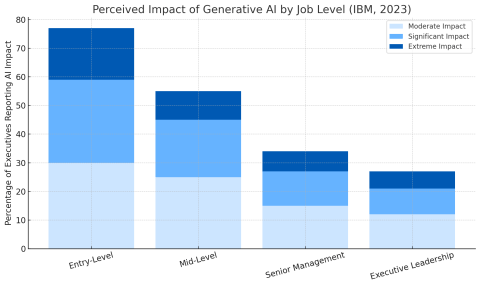
This chart shows how executives expect AI to impact different job levels. Entry-level roles are predicted to be hit the hardest, with 77 percent reporting moderate to extreme disruption.
Is AI going to steal your future job? Not exactly.
Importantly, experts emphasize that this doesn’t mean all beginner jobs will vanish overnight. When AI takes over parts of a job, employees can refocus on higher-value work; for example, using time saved to do more creative problem solving or critical thinking.
In companies that adopted AI, productivity gains even allowed some highly AI-exposed roles to expand rather than disappear. In other words, AI can act as a performance booster; it “allows us to do more” with the same workforce, as Google Chief Executive Officer Sundar Pichai puts it.
Mr. Pichai argues that while AI may automate tedious tasks, it serves as an “accelerator” for productivity and innovation, not a replacement for human workers.
A trend reshaping workplaces is the rise of AI agents, autonomous tools that can complete multistep tasks inside teams. Agents can schedule meetings, pull data from multiple systems, draft documents, generate reports, or monitor workflows without constant human guidance. Companies are starting to deploy them across departments and operations to reduce manual work and support employees. Instead of replacing roles, these agents act like digital teammates.
Real World Example: AI Supporting Workers, Not Replacing Them
One example comes from NYU Langone, a health-care clinic in New York that introduced an AI assistant in their Brooklyn and Suffolk County locations to help medical scribes. The tool summarized patient notes and suggested billing codes, which sped up the documentation process and reduced errors. No one was replaced; the AI simply handled repetitive tasks so the staff could spend more time focusing on patient care.
Still, faced with these uncertainties, educators and business leaders alike caution against an extreme reaction of eliminating junior roles. Harvard Business School’s Amy Edmondson notes that cutting entry-level jobs is short-sighted. These positions are “crucial for developing future leaders.”
Instead of eliminating early-career roles, companies should redesign them to leverage AI for routine tasks while humans focus on judgment, creativity, and collaboration.
Career Readiness in an AI-Driven Job Market
Traditional job preparation isn’t enough anymore. As AI accelerates across every industry, the most career-ready graduates are those who know how to keep reskilling and adapting to new tools. In fact, a 2023 IBM global study found that 40 percent of the workforce will need to reskill within just three years, mainly in entry-level positions. Stanford’s 2023 AI Index report highlights that demand for AI-related skills is rising in nearly every sector of the economy, not just in tech jobs.
There’s also a growing emphasis on responsible AI use. Microsoft’s 2025 AI in Education report notes that while over 60 percent of students have tried AI tools, many lack guidance on how to use them effectively and ethically. Colleges and universities are beginning to fill that gap by integrating AI literacy and hands-on training directly into career preparation.
“Employers expect students to have some knowledge of AI tools, even if they’re not specific about which ones,” says Mr. Beaudet. “Some companies even have internal AI platforms that employees must use, so they want candidates who can navigate these tools confidently.”
Skills Students Will Need in an AI-Driven Workforce
Microsoft’s 2023 Work Trend Index report found that 82 percent of leaders believe employees will need new skills as AI continues to grow. Crucially, “learning to work alongside AI won’t just be about building technical capacity,” the report notes. It will require sharpening analytical judgment, creativity, and empathy; the kinds of soft skills that AI cannot easily replicate.
Employers want adaptive problem solvers who can collaborate with both humans and AI tools. McKinsey’s Generative AI and the Future of Work in America report foundthat individuals who exhibit strengths in “adaptability, coping with uncertainty, and synthesizing information” are more likely to be employed and earn higher incomes in the future. On the technical side, digital literacy and AI fluency will be baseline requirements.
Utilizing AI tools might sound intimidating, but it’s more approachable than you think, and now is the perfect time to jump in.
You don’t need to be a programmer or math genius to explore it. There are tools, courses, and communities built for beginners in every field. Whether you’re into marketing, art, or business, understanding AI will open doors and give you a major edge in your career.
Simple Ways to Start Building AI Literacy
If you’re looking to build AI confidence early, consider trying a few small steps:
- Take a short online course. Free, self-paced options on Coursera, edX, and Google’s AI Learning Hub can help you understand the basics without any technical background.
- Start utilizing AI tools to enhance—not replace—your work. Try using tools like ChatGPT for brainstorming ideas, summarizing notes, or exploring sample problems with AI. You’ll learn fastest by using it regularly.
- Ask questions and stay curious. The more you explore, the more you’ll understand what AI can (and can’t) do.
Leave a Reply