Stock Performance and Market Context
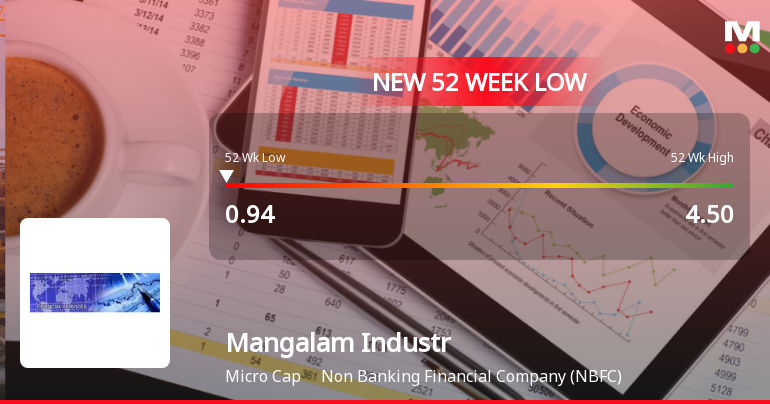
The stock of Mangalam Industrial Finance, a player in the Non Banking Financial Company (NBFC) sector, has been on a consistent downward trajectory, losing approximately 35.62% in returns over the last thirteen days. This decline culminated in the stock touching Rs.0.94 today, its lowest level in the past year. The current price is substantially below its 52-week high of Rs.4.50, reflecting a sharp contraction in market value.
On the day of this new low, the stock underperformed its sector by 4.1%, continuing a pattern of relative weakness. Additionally, Mangalam Industrial Finance is trading below all key moving averages, including the 5-day, 20-day, 50-day, 100-day, and 200-day averages, signalling a persistent bearish momentum.
In contrast, the broader market index, Sensex, experienced a modest decline of 0.37%, closing at 85,395.97 points after a flat opening. The Sensex remains close to its 52-week high of 86,159.02, trading above its 50-day and 200-day moving averages, which indicates a generally positive market environment despite the stock’s underperformance.
Financial Metrics and Valuation Insights
Over the past year, Mangalam Industrial Finance’s stock has recorded a return of -73.82%, a stark contrast to the Sensex’s positive performance of 4.52% during the same period. This divergence highlights the stock’s relative weakness within the broader market context.
The company’s long-term financial indicators reveal modest growth and valuation concerns. Net sales have shown an annual growth rate of 9.92%, which suggests limited expansion in revenue streams. Return on Equity (ROE) averaged 1.90% over the long term, indicating subdued profitability relative to shareholder equity.
Quarterly results for September 2025 reported a Profit Before Depreciation, Interest and Taxes (PBDIT) of Rs.0.31 crore and a Profit Before Tax excluding Other Income (PBT LESS OI) of Rs.0.30 crore, both figures representing the lowest levels recorded in recent quarters. Despite these subdued earnings, the company’s ROE for the quarter stood at 4.2%, accompanied by a Price to Book Value ratio of 4.7, which points to a valuation that may be considered expensive relative to its earnings and book value.
Interestingly, while the stock price has declined sharply, the company’s profits have risen by 53% over the past year. This disparity is reflected in a Price/Earnings to Growth (PEG) ratio of 3.9, suggesting that the market valuation does not fully align with the profit growth experienced.
Shareholding and Corporate Developments
Promoter holding in Mangalam Industrial Finance has decreased in the most recent quarter, now standing at 43.97%. This reduction in promoter stake may be viewed as a factor contributing to market sentiment and the stock’s price movement.
Sector and Peer Comparison
Within the NBFC sector, Mangalam Industrial Finance’s valuation is trading at a discount compared to the average historical valuations of its peers. However, the company’s weaker long-term fundamental strength and subdued growth metrics have influenced its market performance relative to sector counterparts.
Technical Indicators and Market Sentiment
The stock’s position below all major moving averages signals a persistent bearish trend. The 5-day, 20-day, 50-day, 100-day, and 200-day moving averages all lie above the current price level of Rs.0.94, underscoring the downward momentum that has characterised the stock’s recent performance.
Despite the broader market’s relatively stable condition, with the Sensex trading near its 52-week high and maintaining bullish moving averages, Mangalam Industrial Finance’s stock has not mirrored this positive trend. This divergence highlights company-specific factors influencing its price trajectory.
Summary of Key Price Movements
To summarise, Mangalam Industrial Finance’s stock has experienced a significant decline over the past year, culminating in a new 52-week low of Rs.0.94. The stock’s performance contrasts sharply with the broader market’s gains and reflects a combination of subdued financial growth, valuation considerations, and changes in shareholding patterns.
While the company’s profits have shown some improvement, the market valuation and technical indicators suggest ongoing challenges in regaining upward momentum. The stock’s current trading levels remain well below all key moving averages, reinforcing the prevailing downtrend.
Limited Time Only! Upgrade now and get 1 Year of Stock of the week worth Rs. 14,999 for FREE. Don’t miss out on this exclusive offer. Claim Your Free Year →
Leave a Reply