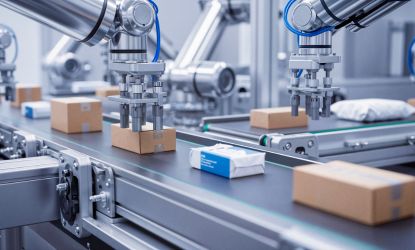
 The production of semiconductor technology has grown into a pillar for the modern tech era, with critical impact throughout almost every major industry, including electronics, automotive, aerospace, healthcare, and national security. As more societies go digital, chips that can function at higher speeds, occupy less physical space, and consume less energy have been produced in record numbers; thus, creating high demand for engineering practices for chip creation and packaging. Semiconductor Manufacturing is now seen to many as being more than an industrial practice; it is considered to be a strategic asset that brings nations technology superiority and strengthens their economic future.
The Strategic Importance of Chip Production
In recent years, global digital transformation has rapidly developed into an unprecedented phenomenon. Advanced semiconductors provide the foundation of Cloud Computing (CC), Artificial Intelligence (AI), 5G Network Technologies, Electric Vehicles (EV), and IoT ecosystems, therefore; the growing demands for these technologies through increased investment have made semiconductor manufacturing a priority for all levels of government and the private sector worldwide. Prior to the recent global chip shortage, both automotive and consumer electronics industries experienced major production delays due to the increasing use of semiconductors in their respective supply chains.
As a result of this impact, many countries including the USA, India, Japan, South Korea, and many EU nations have begun investing tens of billions to strengthen their semiconductor manufacturing capabilities. This involves creating and expanding upon the current semiconductor manufacturing industry, as well as achieving an increase to strategic manufacturing capabilities from both economic and national security perspectives. Advanced semiconductor technologies are critical components of Defence Technologies and secure communications systems. The strategic evolution of the semiconductor manufacturing industry will impact all elements of national security for many governments. Therefore, semiconductor manufacturing is at the heart and soul of the strategic policy framework for many nations.
From Sand to Silicon: The Complex Process Behind Every Chip
Creating high-performance chips is an extremely complex process that involves converting raw materials into finished semiconductor materials. It begins with purified silicon (extracted from sand) being formed into cylindrical crystal forms, which are then made into thin sections (wafers). The wafer is then used as the base for billions of microscopic transistors to be fabricated using lithography techniques.
One of the most complex steps in the manufacturing process is called “lithography.” This process uses ultraviolet light to etch (etch) the transistor circuit pattern onto the surface of the wafer. Using extreme ultraviolet (EUV) technology, the dimensions of the transistors can be created on the nanometer scale, making it possible to create higher-performing transistors with lower power consumption. All of this illustrates the advanced physics and precision engineering required to make semiconductor manufacturing one of the most sophisticated industrial processes ever performed.
After lithography is completed, additional layers of conductive and insulating materials are added through several other processes, including deposition, ion implantation, and etching processes. Each additional layer will be aligned with the previously deposited layers of conductive and insulating materials, thereby creating intricate pathways for the flow of electrical signals. Once all of the layers have been fully deposited, the wafers will be tested, diced, and packaged before being delivered to electronics manufacturers.
Global Leaders and Emerging Players
Companies including TSMC, Samsung and Intel dominate the current semiconductor manufacturing landscape. All three companies are pushing the limits of building devices using manufacturing techniques known as nano-scale fabrication. TSMC in Taiwan is currently the leader in this area with their latest products being manufactured using “advanced 3nm and 2nm process nodes”. These devices range from high-end smartphones to highly powerful artificial intelligence servers. In South Korea, Samsung remains at the forefront of developing both memory chips and logical processing capabilities. Lastly, the United States is experiencing a resurgence in its semiconductor manufacturing ecosystem, in large part as a result of very large investments by Intel, Micron and GlobalFoundries.
However, newer economies are emerging in this sector as well. One such economy is India, who has positioned itself very aggressively in an attempt to become a major global hub for semiconductor manufacturing capabilities. Through initiatives of the Government of India (the India Semiconductor Mission-ISM, Production Linkage Incentives-PLIs) and considerable interest from global semiconductor companies, India is developing the necessary infrastructure to be able to establish large scale semiconductor manufacturers (fabs), assembly and test facilities and chip design centres. These infrastructure assets will provide job opportunities in India, reduce dependency upon imported components and improve India’s position in terms of technological competitiveness globally.
Technological Advancements Reshaping the Industry
“Breakthroughs that are Changing Semiconductor Manufacturing to the Future”.
- Advanced Lithography – Manufacturers of semiconductors are adopting EUV lithography, which expands their ability to decrease transistor size while keeping up performance and yield and also provides a way for semiconductor manufacturers to exceed conventional limits imposed by Moore’s Law.
- Chiplet-Based Architectures – Chiplet architecture provides a way for the semiconductor manufacturer to utilize multiple small pieces of silicon instead of one large piece of silicon integrated into a single die. This gives chip manufacturers more flexibility, scalability, and cost-savings to create ‘AI’ and data center processors as opposed to only one type of computer processor.
- 3D Packaging – The introduction of 3D stacking technology has allowed chips to be manufactured vertically in 3D, thus eliminating latency between the individual chips while increasing the bandwidth available between each chip. The introduction of 3D stacking is changing the way systems are built from CPUs to mobile devices to edge AI.
- New Materials – In addition to silicon-based semiconductor technology, new materials such as gallium nitride (GaN), silicon carbide (SiC), and graphene have emerged as key materials for manufacturing semiconductors for high voltage, high frequency, and ultra-high-speed applications.
- Automation & AI-Driven Yield Optimization – The use of automation and AI algorithms has led to improved defect detection, optimization of production runs and forecasting for equipment maintenance, thus increasing yields, reducing downtime, and speeding up production cycles.
The Road Ahead: A New Era of Global Innovation
Future trends in semiconductor production are bright because many cutting edge technologies such as artificial intelligence and machine learning will generate more demand for advanced chip design. This creates great opportunity for investment from countries or companies that choose to focus on research and development (R&D), build state-of-the-art facilities, and develop the workforce capable of doing all the development work necessary to produce these nextgeneration semiconductors.
Sustainable manufacturing will continue to drive manufacturers toward eco-friendly practices, including but not limited to water reuse and minimization of chemicals used in the manufacturing process. Energy-efficient machinery will also play an integral part in helping companies achieve their environmental goals. Therefore, all manufacturers will be required to develop sustainable processes to remain competitive in the future.
By 2030, semiconductor manufacturing will be the primary driver of technology competitiveness globally; any country with a competitive advantage in this area will dominate the world market in automation, digital government services and program delivery, smart transport and logistics systems, and national security. As a result, it is imperative that both R&D and Fab (manufacturing technology) continue to advance rapidly on an ongoing basis.
 Follow the Bisinfotech WhatsApp channel to stay updated on India’s new technology ecosystem
Leave a Reply