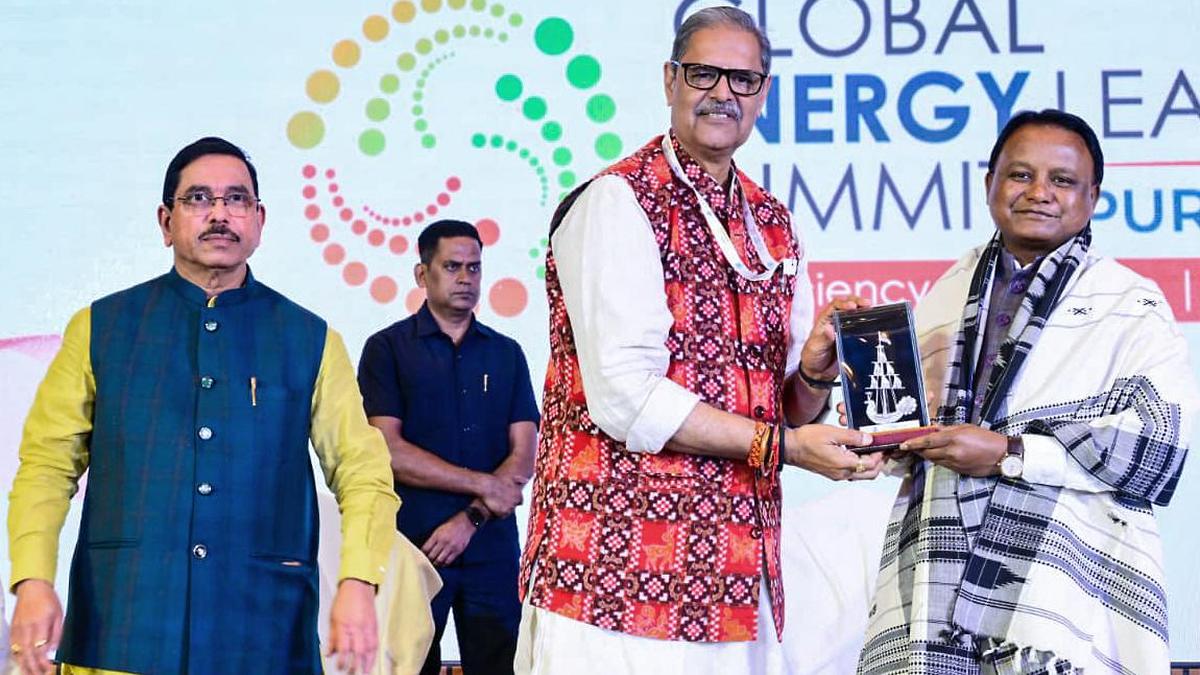
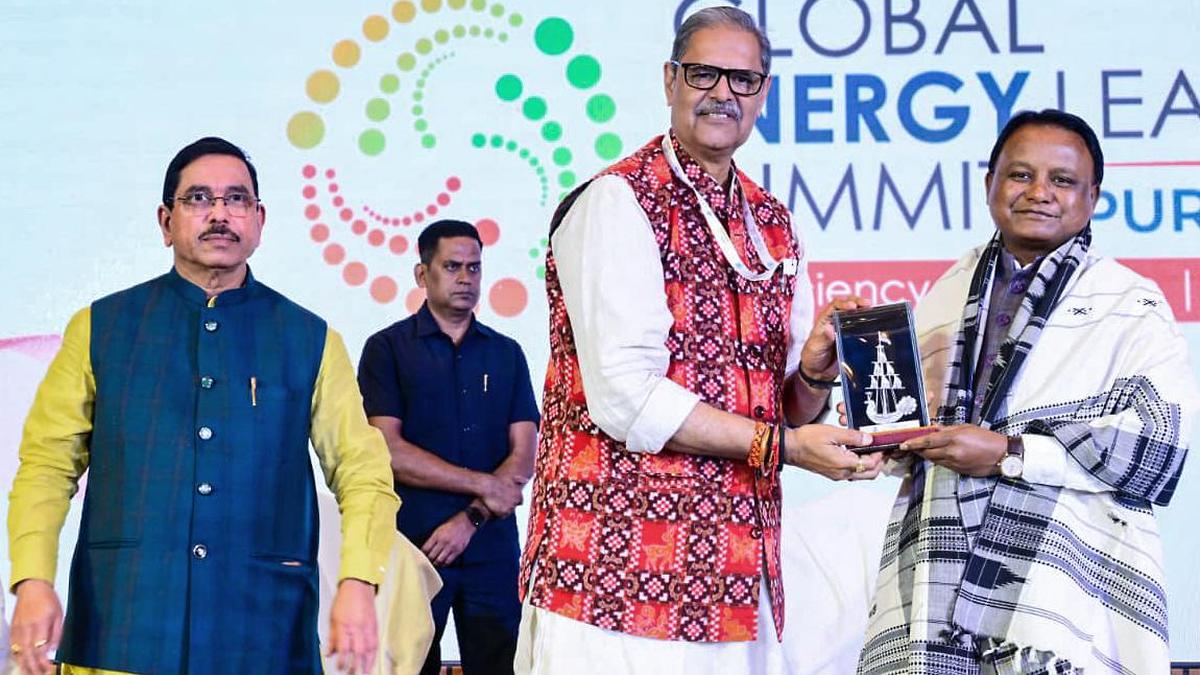
Odisha CM Mohan Charan Majhi being felicitated by Deputy CM Kanak Vardhan Singh Deo during the Global Energy Leaders’ Summit, in Puri on December 6, 2025.
| Photo Credit: ANI
Energy leaders and policymakers have called for creating a diversified portfolio of future-ready power system technologies, including advanced transmission networks, flexible generation resources, and modern distribution systems to ensure reliability, resilience, and security of supply, with India steadily moving to achieve a target of 500 GW non-fossil capacity.
At the conclusion of the Global Energy Leaders Summit here at the coastal town of Puri on Sunday (December 7, 2025), States were urged to accelerate joint deployment of energy storage systems, including battery energy storage, pumped storage hydropower, and long-duration storage technologies, to enable round-the-clock renewable energy and grid stability.
The two-day-long summit orgnised by the Odisha government and the Tony Blair Institute for Global Change was attended by Ministers of Energy of different States, and global energy experts.
The gathering agreed to, and issued a statement on, a unified coordination platform for joint planning and implementation of India’s energy roadmap, supported by shared knowledge and a data hub, study missions by a Group of Ministers and regular inter-State dialogues, and issued a statement on this
“All of us will agree that energy transitions are not won on installed capacity alone. They are won on system adequacy — on whether the lights stay on when the wind doesn’t blow and the sun doesn’t shine. They are won on financial viability — on whether our discoms (power distribution companies) can borrow, invest, and survive without being permanent wards of the State,” K.V. Singh Deo, Odisha Deputy Chief Minister and State Energy Minister, said.
“They are won on political courage — on whether we are willing to reform tariffs, retire coal assets responsibly, and tell hard truths to our constituents about the cost of clean energy,” Mr. Singh Deo added.
Experts agreed to accelerate energy efficiency and conservation across the residential, industrial, commercial, agricultural and municipal sectors to achieve national energy intensity reduction targets and strengthen India’s 2030 climate commitments.
Clean energy research is one of the fastest growing sectors in the world, with almost two trillion dollars of investment having gone into it, B.V.R Subrahmanyam, CEO, NITI Aayog, said, addressing the summit.
“The sector is going to be a huge job generator. Not just innovation and investment, but also a lot of skilling of people will be required,” Mr. Subrahmanyam said.
Published – December 07, 2025 09:44 pm IST
Leave a Reply