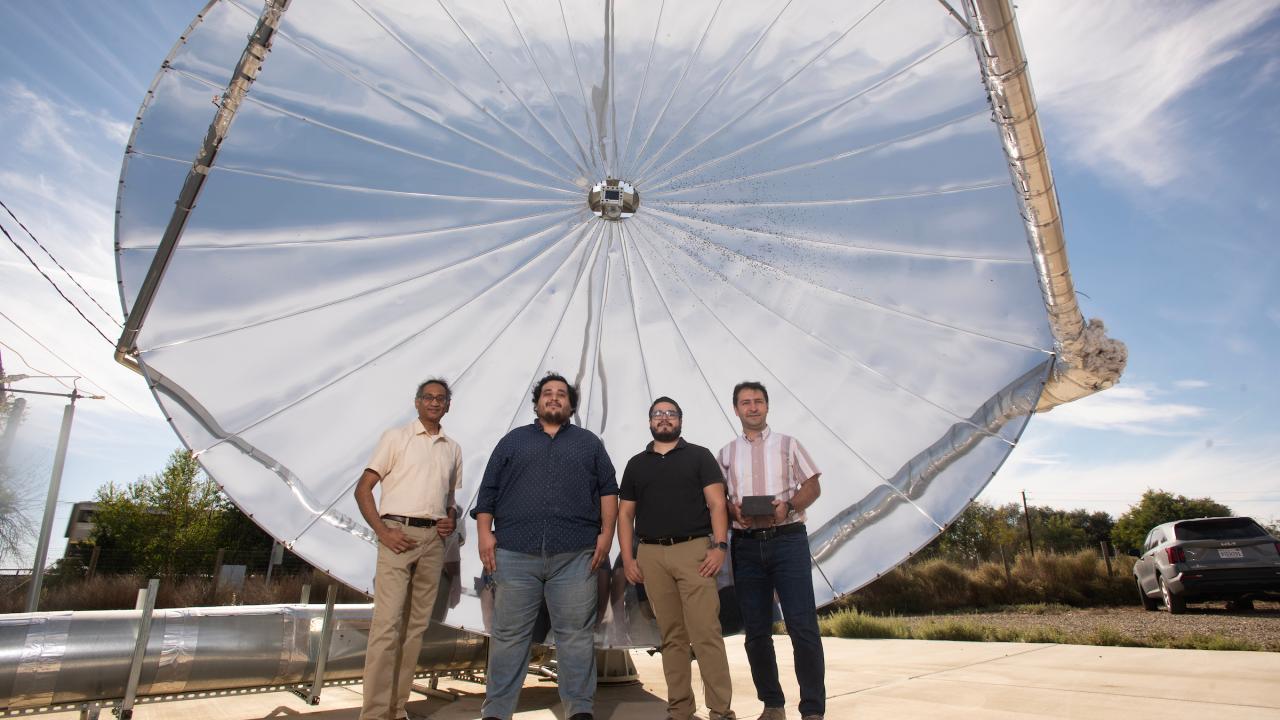
A project to capture solar heat for industrial use — with potential spinoffs in other energy areas, including nuclear power — has been canceled by the U.S. Department of Energy on the cusp of its final phase. The University of California, Davis, received a letter from the federal agency stating that the work “does not effectuate the Department of Energy’s priorities.”
“The project was supporting our nation’s competitiveness in advanced manufacturing for energy security, and it is a shame to see it terminated,” said principal investigator Vinod Narayanan, professor of mechanical and aerospace engineering at UC Davis. “These new technologies will pave the way to reducing costs of industrial processes like drying and chemicals processing.”
The project was originally funded in 2022 for up to $4.6 million over three years.
Led by UC Davis, the project includes academic partners at Carnegie Mellon University, Pennsylvania State University, the University of Michigan and Utah State University as well as Sandia National Laboratory. Industry partners include Sunvapor Inc. of Pasadena, Calif., MRL Material Resources LLC of Xenia, Ohio, and AMETEK Specialty Metal Products, Berwyn, Pa.
Solar-thermal power collects and concentrates heat from the sun so it can be used directly, for example in industrial-scale drying, or to generate electricity. It requires new types of heat exchangers made of materials that can withstand high heat and pressure, transfer heat efficiently, tolerate rapid changes in temperature when the sun rises and sets, and continue working for decades.
These types of materials and devices could also be used in other high heat/high pressure applications, such as in nuclear power plants or industrial processing.
Testing superalloys
The team has built test devices that are 3-D printed from nickel superalloys. These devices contain millimeter-scale channels that carry a working fluid under high pressure. The fluid carries away heat that can be used directly or to generate electricity.
The project has made use of the Solar Thermal Energy Enhancement Laboratory (STEEL) at UC Davis, a 7-meter parabolic dish designed to concentrate sunlight almost a thousand-fold onto a small target area.
The researchers had completed work possible with the STEEL dish and were ready to scale up to a test at the National Solar Thermal Test Facility operated by Sandia in Albuquerque, N.M., Narayanan said.
The UC Davis STEEL facility itself may now be decommissioned. Six graduate students, one at UC Davis and five at partner institutions, are affected by the termination. In addition, research engineers at the UC Davis Western Cooling Efficiency Center and partner companies have also been impacted.
The solar heat research is among dozens of projects and studies at UC Davis that have been terminated or threatened by the loss of federal grants since February. Studies into Alzheimer’s disease and other dementias, sustainable transportation, agricultural science and disease resistance, and other areas have been affected. Many of the terminated awards have since been reinstated. Other notices of termination remain disputed in court or procedural appeals with the agency. Historically, the federal government has been the largest source of research funding for UC Davis and other research-intensive universities under a partnership that formed after World War II.
Leave a Reply