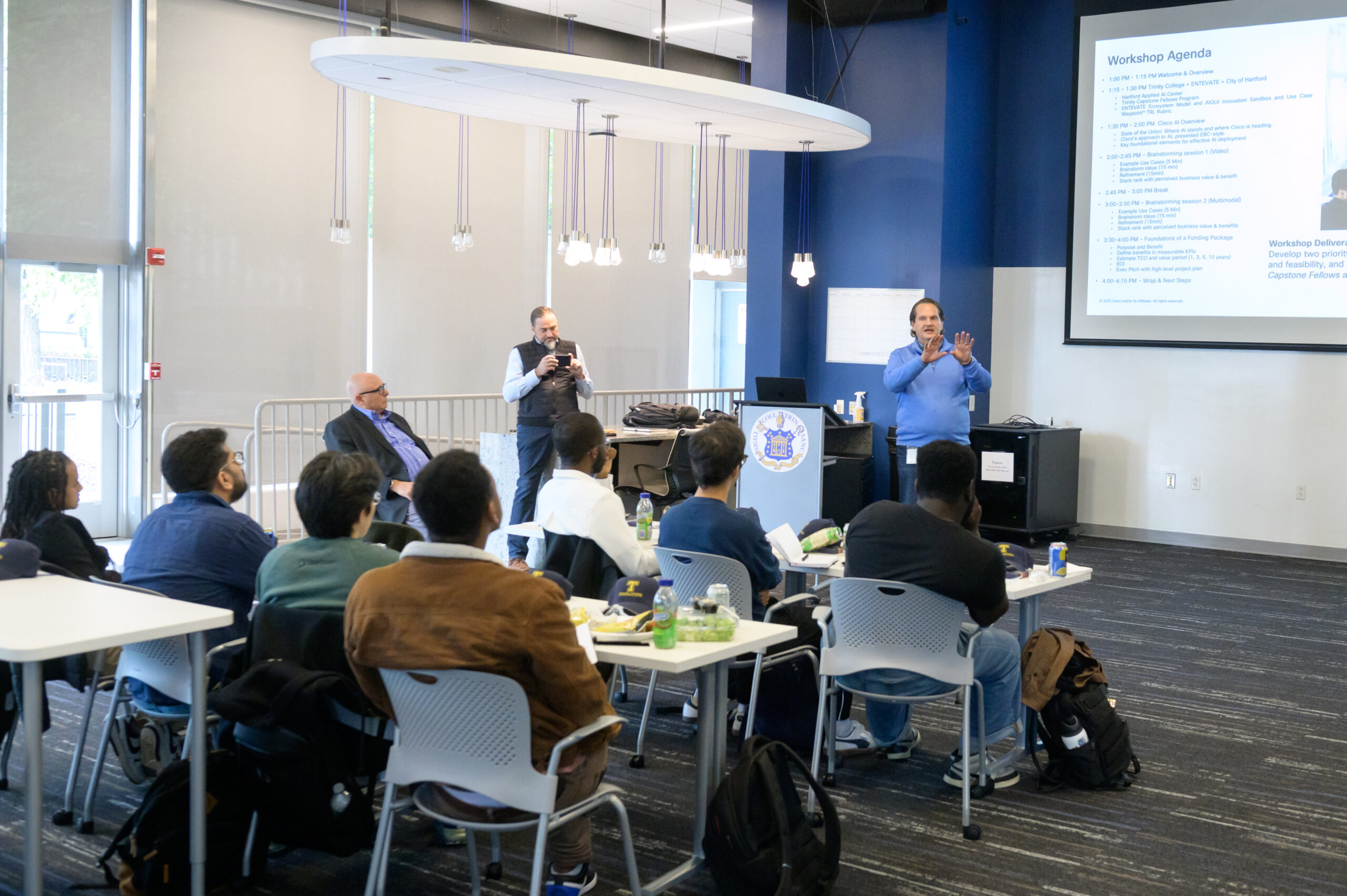
A group of computer science majors at Trinity College are part of a pilot program from Trinity’s Entrepreneurship Center that is developing new uses of artificial intelligence with business and community partners.
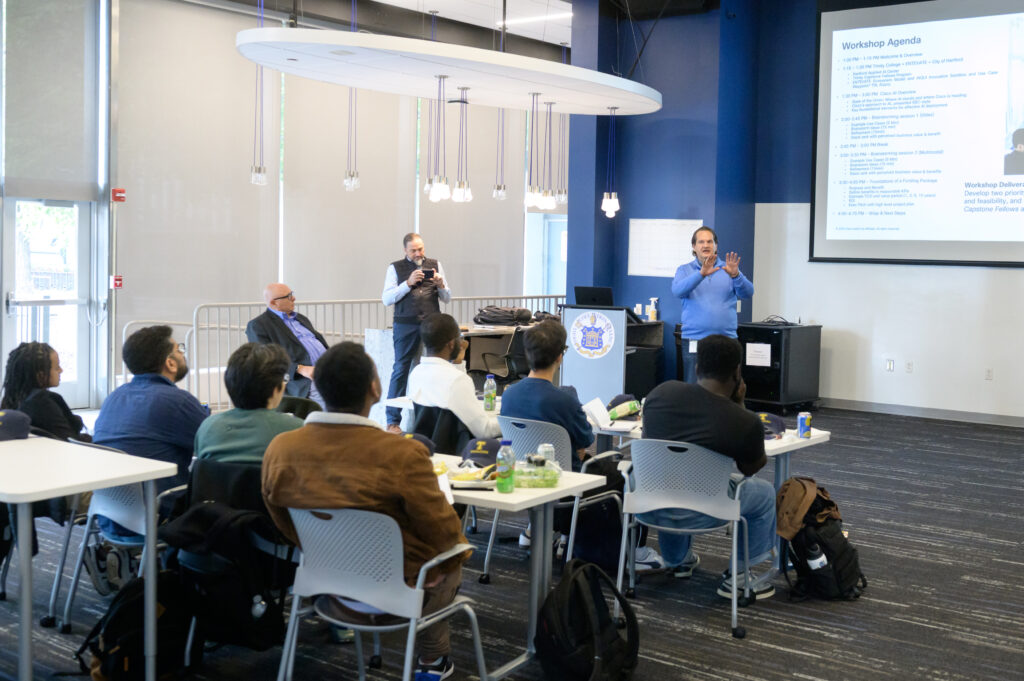
The nine seniors participating in the capstone project received training in the fall semester from the Project Management Institute to prepare them to serve this spring as Applied AI + Quantum Innovations Capstone Fellows. The students are the inaugural cohort of the ENTEVATE AI and Quantum Innovation (AIQUI) Sandbox @ Trinity College. Clients will present use case scenarios to “scrum teams” made up of students, faculty, third-party AI professionals, rapid proto-typers, and vendors who will work together to find creative, AI-based solutions to real-world problems.
Kenneth A. Kousen, visiting professor of the practice in computer science and associate director for STEM initiatives in Trinity’s Entrepreneurship Center, meets with the students weekly to advise on this project, which aims to prepare students for the workforce and to help them discover the many possible uses of AI.
“We don’t know what impact AI will have on our lives, but a student who can work with these tools will have an advantage,” Kousen said. “These students have the opportunity to work with companies that are well established in the field, try out all the AI tools, apply them to real problems, and learn for themselves what they can and can’t do.”
 Danny Briere, Ruane Family Executive Director of Trinity’s Entrepreneurship Center, worked with the Ecosystem and Innovation Roadmapping team at ENTEVATE to bring the AIQUI Innovation Sandbox Fellowship to Trinity. “Students are getting trained in real-world skills that employers want, but are not typically taught in college,” Briere said. “That implicitly gives our students a leg-up in the employment process.”
The students, working in teams, will tackle client use cases from Connecticut Children’s Medical Center, the City of Hartford, Ticket Network (a live-event ticket marketplace), the non-profit Connecticut Invention Convention, and Xapa, a Silicon Valley-based, AI-centered workforce development startup. Rapid-development teams from Cisco Systems, Google, and Microsoft will work with the client technical teams, ENTEVATE experts, student teams, and specialty platform vendors—like SoftServe for Large Visual Model (LVM) analysis and Purple Lab for data anonymization—to craft AI-powered solutions.
The City of Hartford use case, for example, involves using AI to help the City analyze CCTV video to determine where drivers run the most red lights, in order to inform the City as to where to place recently-approved red light traffic cameras for enforcement purposes. More AI platforms and vendors are being added to work with later use case teams, Briere said.
“This kind of work is super hands-on, and it really differentiates our students,” Briere said. “We want Trinity to be seen as a strategic partner—more than just a provider of interns. We’re working together with major enterprises to solve their strategic problems.”
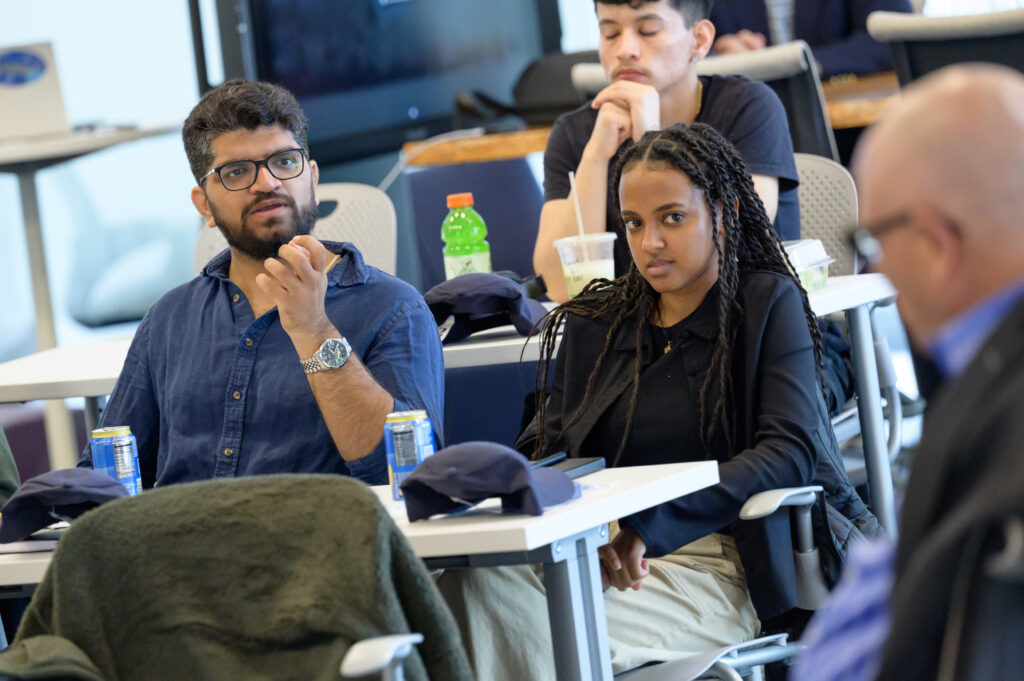
 The Trinity students in this program see clear value to this experience. Yeabsira Bizualem ’26, a computer science major and applied mathematics minor from Ethiopia, said that the training helped her get used to the terminology and technology she will use in this role and potentially in future employment. “With the way we approach a problem, you can see the results in real-world applications,” she said. Bizualem added that this project will provide industry experience and help her develop stronger interpersonal skills. “I hope to be a good competitor in the job market,” she said.
Shivanshu Dwivedi ’26, a computer science and physics double-major who came to Trinity from India as part of the Next Genius Scholarship Program, said that knowing a little about computer science can help in any field. “I really wanted to work on applied AI. If you don’t know how to work with AI through different use cases, you’re missing out,” he said. “This opportunity gives us a chance to work with companies that have valuable and practical use cases for AI, and they provide us with their guidance and their resources; we just have to use and develop our skills and build things that could make a positive difference.”
Kwaku A. Agyapong ’26, a computer science and Francophone studies double-major and philosophy minor from The Bronx, New York, said that he wants to develop his technical abilities, along with skills in communications and professional relations. “This is working with real stakeholders who have an interest in tangible solutions that manifest in people’s lives. The ‘applied’ part of ‘applied AI’ makes all the difference; it’s a piece of the real world. Getting exposed to that as seniors, going into our professional lives, is invaluable,” he said. “I’m hoping to make the most of this opportunity and to use it to help get a job.”
The goal is for each student to work on one use case study through the end of the spring 2026 semester, when their final projects will be presented to the clients and a representative from the Travelers, which awards prizes to the best of the Computer Science Department senior projects.
The Trinity student project managers met with their first team, from Cisco and the City of Hartford, on October 24 at 10 Constitution Plaza, where they also were joined by Michael Binko, ENTEVATE’s managing director of innovation, ventures, and ecosystems.
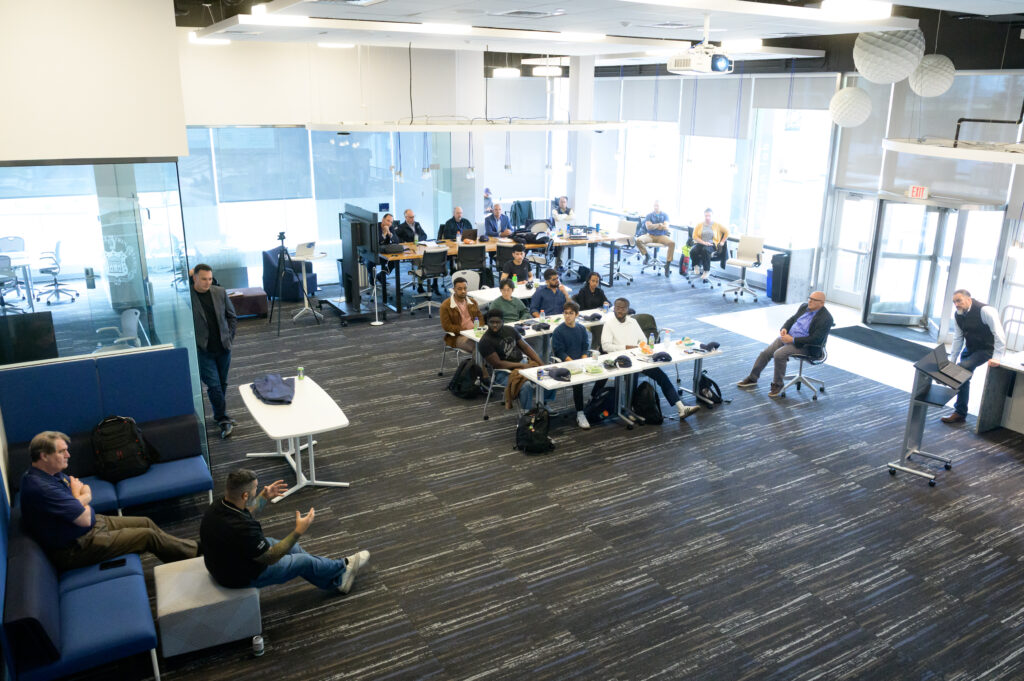
“The Innovation Sandbox is a way to engage with larger companies wanting to test new innovations with a lens toward meaningful metrics and outcomes for their operations. These organizations need a talented workforce trained in new innovations and how to use them,” Binko said. “We had the idea with Cisco to bring in educational institutions that have students assigned to work on use cases with innovators and clients.” Trinity is the first academic institution to onboard AIQUI Innovation Sandbox Fellows.
At the October 24 workshop, representatives from Cisco spoke about how their company looks at the emergence of AI for their customers, and ENTEVATE and Cisco facilitated conversations with students about examples of use cases.
Even with new leaps in technology, Binko said that smart companies continue to invest in human capital. “Having the talented people that can help them navigate to a result is what matters,” Binko said. “And liberal arts-trained minds seem to have a better success quotient than others. They’re trained in broad skillsets, are willing to ask questions, and work well in teams. Liberal arts students are the best equipped innovators. Also, one of the more unique aspects of the Trinity approach is the combination of core computer science skills with perspectives and learnings from the Entrepreneurship Center. This combination of degree-related and Life Design/career roadmapping is going to be a true differentiator for the Capstone Fellow students when they embark on their job-seeking efforts before and after graduation. They will definitely separate themselves from their peers on meaningful levels.”
Trinity College is collaborating with the City of Hartford to build workforce development pathways for students in AI and advanced technologies, Briere said. The City of Hartford has announced plans to build an applied AI center downtown and Trinity is the first college to engage with that initiative, with students actively working on AI use cases.
Briere added that he plans to bring more opportunities like this to Trinity students. “Trinity’s Entrepreneurship Center is just as much involved with innovation as with anything else we do,” he said. “We want to be part of leading-edge technologies like AI and robotics. Our mission includes creativity, invention, innovation, and entrepreneurship.”
For more information about Trinity’s Entrepreneurship Center and how to get involved, click here.
Leave a Reply