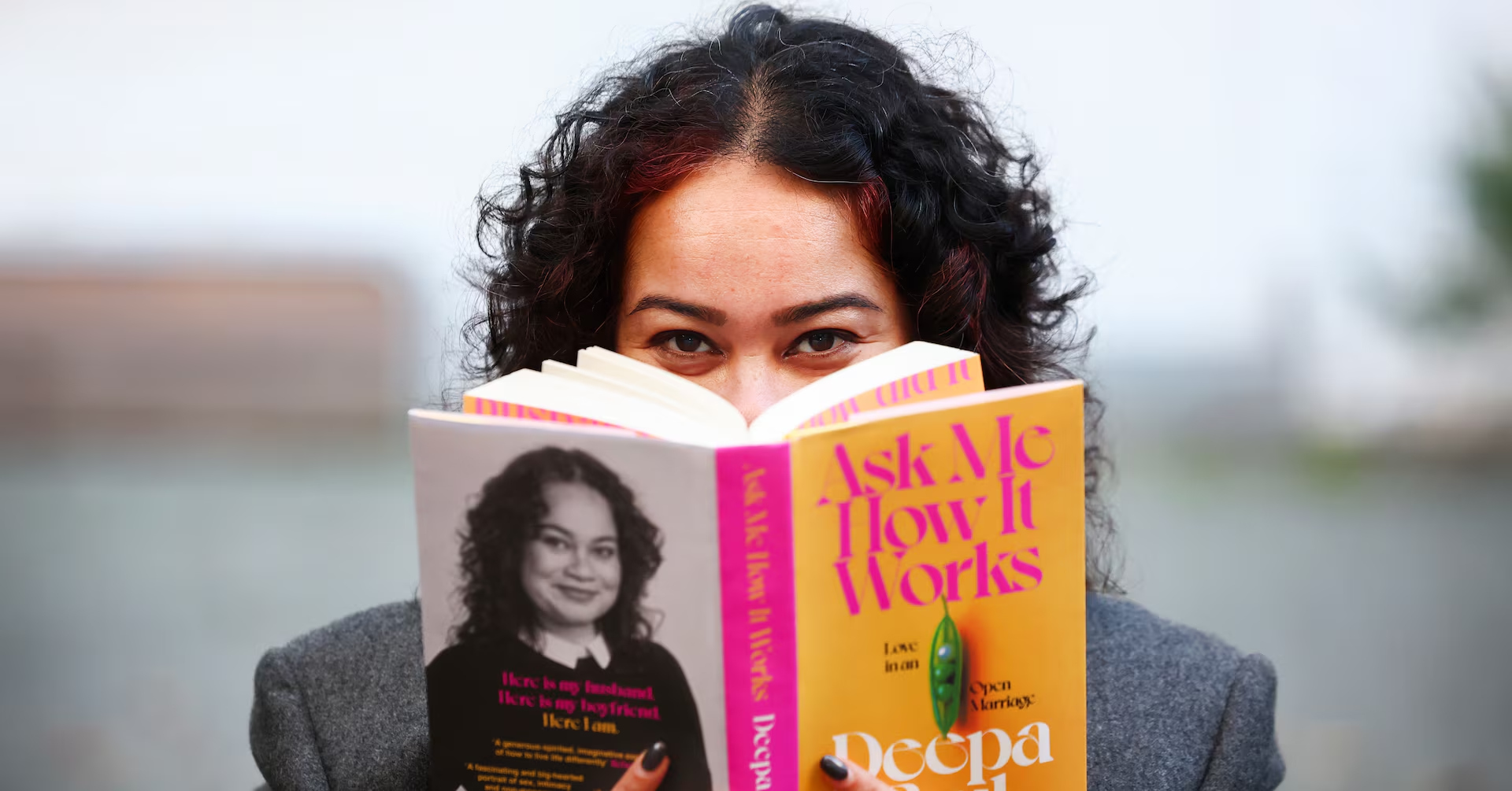

Deepa Paul, the Indian-Filipina author of her memoir “Ask Me How It Works”, poses in Amsterdam, Netherlands, November 7, 2025. REUTERS/Piroschka van de Wouw
When Indian-Filipina author Deepa Paul and her husband agreed not to be monogamous a decade ago, she never imagined she’d write a book about it — much less introduce her boyfriend to her husband and then to her mother in the deeply Catholic Philippines, where Paul grew up and where divorce remains illegal.
This conversation has been edited and condensed for clarity.
What inspired you to write this memoir?
“Ask Me How It Works” began as an essay. When we opened our marriage 10 years ago and I first started using dating apps, I kept getting the same questions. People who were interested in dating me wanted to know how it worked. I realized it would be easier if I wrote an article I could share with them, as a joke.
I tried to get it published then, but no one was interested in open marriages at the time. So, I shelved it. During the pandemic, my copywriting work dried (up) and I had time to revisit unfinished projects. I wanted to have it published in the New York Times’ Modern Love column, but it has a brutal word count of about 1,700 words. Meanwhile, I had (written) a 6,000-word monster. My writing coach said, “Why are you trying to cram this into 1,700 words? This is not an essay. This is a book”. That was my aha moment.
Do you think public attitudes toward open marriage have shifted since then?
Absolutely. When we opened up, it was quite a niche lifestyle choice that no one spoke about. Everyone on dating apps was monogamous. Now, things are different and non-monogamy has entered the mainstream conversation. The pandemic played a huge part. So many relationships changed during that period. Marriages that were already shaky fell apart, and a lot of people started rethinking what they wanted after experiencing isolation, loneliness, and breakups.
Media has also portrayed open relationships more, I guess because they know it’s a hot topic and, of course, sex sells. There’s still a big assumption that anyone who’s non-monogamous is doing it for the sex.

Deepa Paul, the Indian-Filipina author of her memoir “Ask Me How It Works”, poses in Amsterdam, Netherlands, November 7, 2025. REUTERS/Piroschka van de Wouw
The pope likens polygamy, polyamory, and adultery, and I disagree with that. They’re very different things. Aside from his use of the word “exclusive,” though, I don’t actually object to the substance of what he says.
He describes monogamy as mutual belonging based on the free consent of the spouses, a commitment that’s meant to strengthen the stability of the relationship without disrespecting anyone’s freedom or identity. I was married in the Catholic Church, and my marriage still involves only one spouse. We maintain certain things as exclusive to each other, like finances, parenting, and our household, and for us that doesn’t conflict with being polyamorous.
In any case, I don’t want to take relationship advice from single men who have never been in a relationship.
You write that an open marriage cannot save a relationship. Can you elaborate on that?
Opening up your marriage to save it is like having a baby to save it. It feels like something that could be potentially exciting: bringing some new, fresh energy into your relationship. But it also brings a lot of unpredictable situations. You bring in people who have their own feelings, their own conflicts, their own desires and it really boils down to how you as a unit, as a relationship, handle this.

Deepa Paul, the Indian-Filipina author of her memoir “Ask Me How It Works”, poses in Amsterdam, Netherlands, November 7, 2025. REUTERS/Piroschka van de Wouw
Most people assume open relationships are a free-for-all: “I can do whatever I want, whenever I want with whomever I want.” What an open marriage actually needs is a lot of commitment to be able to ensure that everyone’s feelings are okay. One person’s adventure might be somebody else’s disaster.
With ethical non-monogamy, you’re asking for a lot, which means that you have to give a lot, and this is not always factored in. For me, the foundation of my open marriage is still commitment. Otherwise, I would have just left my marriage.
Of all the reactions that you’ve received to your open marriage, which one surprised you the most?
My mother’s. She is 76 years old and lives in the Philippines, a very conservative, Catholic country. Divorce is not enshrined in the legal system. A lot of people’s perspectives about marriage, commitment and intimacy are very religion-driven there. It is still very much taboo, especially for a woman, to be open about sexuality and desire.
I told my mother about my open marriage about four years ago, once I knew I wanted to publish this book.
Even though she didn’t know what an open marriage was, she almost took the words out of my mouth by saying: “I know you have something going on where you’re each other’s life partner and you love each other, but you have other people in your lives and you are free to have other relationships.” It was really liberating for me to have her non-judgmental acceptance.
She met (my boyfriend) Robert when we were still together last year and it went really well.
In your book, you mentioned being surprised that some of your daughter’s classmates’ parents were also in open marriages. Do you think the Netherlands is a particularly accepting place for that compared to other countries?
Dutch culture is more individualistic and combined with the famous Dutch tolerance; it creates space not just for open marriages, but for unconventional lifestyles. You can make choices outside the norm and find others doing the same.
Then you have the Philippines, which is a very collective society where families are very intertwined. It’s also a country where some people are struggling for economic survival. It’s not hard to see why open marriage is not a thing there; you have to eat first.
Here in Amsterdam, I’m able to live freely as a liberated woman because I have economic security and I don’t depend on my husband. That freedom makes me braver in pursuing the life I want. For women who rely on men for financial support, it inevitably shapes their relationships.
Most people assume open relationships are a free-for-all … What an open marriage actually needs is a lot of commitment to be able to ensure that everyone’s feelings are okay. One person’s adventure might be somebody else’s disaster.
Deepa Paul
Are open relationships the future of relationships?
They’re a future. It’s not a new thing, it’s always been around, and monogamy is not going anywhere either. It’s positive that more people understand (that) non-monogamy is an option. There’s eight billion people on the planet — there cannot be just one way for people to love and have relationships.
If we’re starting to embrace diversity in terms of people’s experiences, thoughts, (and) gender, it is a natural progression to also see more diversity in the way we conduct our relationships and love and want to be loved.
What kind of conversations do you hope the book triggers with people?
I think the most important conversation anyone can have after reading this book is with themselves. What did I find triggering? What sparked my curiosity? What did I resonate with?
Speaking from experience, I grew up in an environment — and was socialized as a woman — where I never really learned to pay attention to my own needs or curiosity. I hope the book will get people asking themselves what they want, and to then bring the answer into conversations with their loved ones.
It doesn’t need to be a conversation about opening up your marriage, but about desire. The book makes those conversations possible, and I hope people have them.
The perspectives expressed in Culture Current are the subject’s own and do not necessarily reflect the views of Reuters News.
Sign up here.
Editing by Yasmeen Serhan and Aurora Ellis
Our Standards: The Thomson Reuters Trust Principles.
Leave a Reply