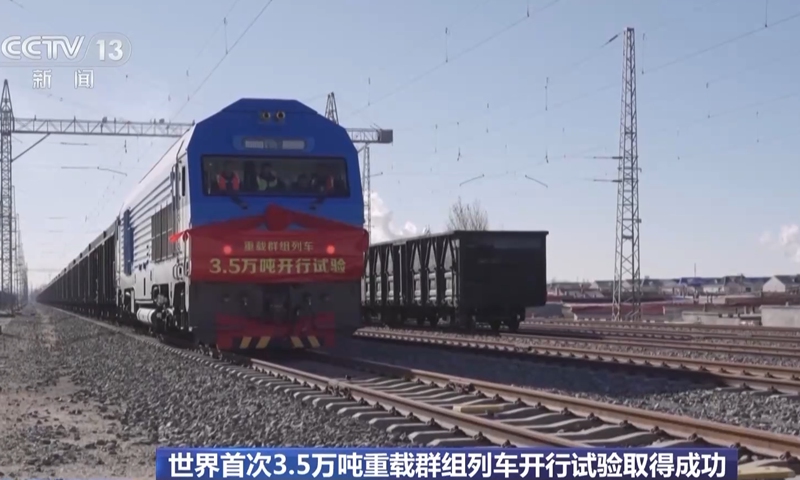
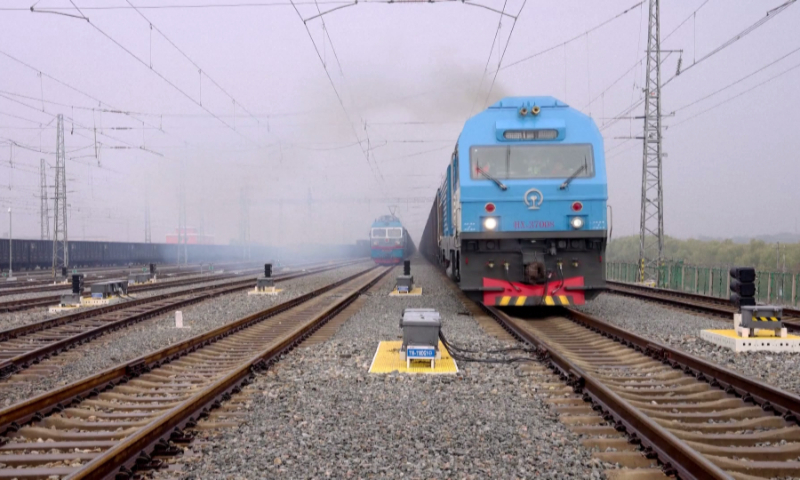
The world’s first 35,000-ton heavy-haul train group operational test is successfully conducted on the Baoshen Railway in North China’s Inner Mongolia Autonomous Region on December 8, 2025. Photo: VCG
The world’s first 35,000-ton heavy-haul train group operational test was successfully conducted on the Baoshen Railway in North China’s Inner Mongolia Autonomous Region on Monday. The test marks the first time that globally, multiple freight trains have achieved synchronized operation using instant wireless signals, without any mechanical coupling, according to a report by China Central Television (CCTV) on Monday.
A Chinese industry analyst said that the success of this trial will fundamentally reshape the existing railway technology system and revolutionize global heavy-haul railway technology. The technology could be applied to high-speed rail, urban rail transit, and conventional railways, providing core technical support for China’s railway industry and driving the global advancement of heavy-haul train control systems toward greater efficiency, safety, and intelligence.
A major challenge of the test was to enable seven freight trains – each carrying 5,000 tons of freight – to connect with each other without mechanical coupling. Instead, the connecting process was completed using China’s independently developed intelligent control system, under which the seven trains achieved perfectly synchronized acceleration and braking throughout the journey guided by wireless signals, with no collisions or separations occurring, the CCTV report noted.
The 35,000-ton train consist represents the longest heavy-haul train group test in China, according to a report by the Science and Technology Daily on Monday. During the trial, seven separate train groups – located at the Nalingoumen, Shabazi, Guannianfang, and Dalad North stations in Inner Mongolia on the Baoshen Railway – were dynamically formed into a single “virtual train group” through wireless “virtual coupling.” The trains operated in close-tracking, fully synchronized mode and eventually traveled to the south yard of Wanshuiquan South Station, where they automatically decoupled and entered the station separately, the report noted.
In China, freight trains have traditionally operated as single units, and it is a very difficult mission to make seven “giant truck”-like trains run in coordinated formation on the same railway track without any physical connection while maintaining perfect synchronization.
The system, which was jointly developed by China Shenhua Energy Co in collaboration with multiple organizations, represents China’s homegrown technological innovation.
“China’s high-speed rail control system has reached the world’s leading level. Building directly on that foundation, we have successfully upgraded our heavy-haul freight train control system to the same cutting-edge level, making it a global leader as well,” Sun Zhang, a mass transit expert and professor at Shanghai Tongji University, told the Global Times on Monday.
Sun added that China’s railway technology has three “calling cards,” which are high-speed railways, freight trains and plateau railways.
Following the success of the test, China could increase its railway freight transport capacity by more than 50 percent without the need to construct new rail lines. It would offer the world a Chinese technological solution to address the challenge of enhancing heavy-haul railway transport efficiency, according to the CCTV report.
Global Times
Leave a Reply