Of all the Sephora stores that have gone through the beauty retailer’s new redesign, the Champs-Élysées flagship in Paris is probably the most glam. There’s a long red carpet, high ceilings and a giant table for everything that’s trending on social media.

“They say that this store gets more visits than the Eiffel Tower,” Deborah Yeh, Sephora’s global chief marketing officer, says as we walk through the crowded boutique on a fall afternoon. We stroll past a fragrance section where perfume bottles stand proudly on their own tables, begging to be spritzed. Hair care has moved to the front of the store; makeover chairs, once near the front, now sit in the middle of the floor.
Outside, the city is locked in a state of unrest. The French government has collapsed, with protesters shutting down streets over budget cuts and workers threatening to strike. Inside, women are dabbing moisturizers, sampling eye shadows and swabbing lipsticks.
“When things are bad, we turn to things that actually give us small comforts and joy,” Yeh says. It’s why lipstick and perfume reliably sell in times of economic turmoil. The day before, I’d heard something similar from Catherine Spindler, president of Sephora Europe and the Middle East, who was gearing up for SEPHORiA, the company’s multicity event for beauty fanatics.
“We provide that taste of something positive, something colorful in difficult times,” Spindler says, sitting in a Paris convention center that was being transformed into a Coachella-style festival, with carnival games, photo booths, matcha drinks and samples upon samples of cosmetics meant to make attendees look, feel and smell amazing. “It’s a destination of happiness.”
Owned by the French conglomerate LVMH, 56-year-old Sephora is the world’s largest “prestige” retailer of cosmetics, skin care, hair products and perfume. It’s a place of discovery for beauty fans who are constantly on the hunt for the next great thing, encouraging customers to test before they buy.
In a luxury downturn that’s lasted more than a year, Sephora remains a bright spot in the LVMH portfolio. The company saw record earnings in 2024, with LVMH CEO Bernard Arnault boasting to analysts this past January that he couldn’t share the full profits LVMH has reaped from the beauty retailer over the decades “because you would not believe them.”
The $450 billion global beauty industry is now at a crossroads. Titans like Estée Lauder and L’Oréal are contending with shifting consumer tastes. Buzzy new beauty brands are arriving faster than ever, reshaping the map of influence. Just two years after launching its beauty division, LVMH rival Kering sold it to L’Oréal in mid-October. In the fall, Reuters reported LVMH was looking to sell its stake in Fenty Beauty, the cosmetics label it created in 2017 with the singer Rihanna. LVMH declined to comment on the matter.
Sephora faces steep competition: Amazon has been pulling in shoppers with discounts, and the more-accessible Ulta Beauty has been gaining market share. The arrival of TikTok Shop and affiliate companies like ShopMy are also chipping away at Sephora’s profits.
But in the global beauty arms race, Sephora intends to stay on top by focusing on its customer experience.
Sephora’s new stores resemble nothing so much as Sephora’s old stores. This is true even of the Champs-Élysées location. The lighting is bright, the space is bathed in the company’s signature black-and-white, and the line is as long as ever. “We feel that our focus on creating a sense of uniformity in our stores has proven worthwhile,” a Sephora spokeswoman later writes in an email.
I watch a trio of girls laugh at horny Tom Ford fragrance names and a woman with a gray bob hum to herself as she tests blushes. A mom waiting in the checkout line is so locked into browsing the minis section, she doesn’t notice her baby is missing a sock.
“Every square inch of this place has to be productive,” Yeh says. “Everything is a little jewel.”
GUILLAUME MOTTE, Sephora’s global president and CEO, appears triumphant when we meet at Sephora’s San Francisco headquarters in September.
Hailey Bieber’s Rhode brand had just debuted at Sephora, drawing crowds eager to take selfies and try on lip gloss. Sephora North America CEO Artemis Patrick, who is sitting next to Motte at a conference table, says it’s the biggest launch in her region to date.
“We’re not naive about competition,” Motte says. “But Sephora is winning.”
Sephora experienced “exceptional” growth in 2023 and 2024, he says. Revenue hit €16 billion, or about $18.5 billion, he says, referring to figures Arnault shared in April. The market is slowing, Motte says, but he predicts Sephora will reach €20 billion (approximately $23 billion) in annual sales “in the near future.”
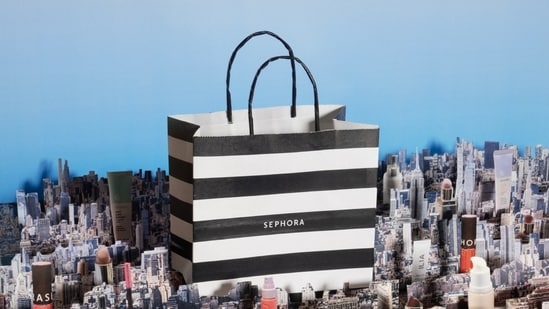
Sephora has 3,400 stores around the world, with over 600 in the U.S. alone. It sells around 300 upscale beauty brands in the U.S., half of which you can’t find in other stores. Its little black-and-white shopping bags are inescapable.
Landing inside Sephora remains a beauty founder’s dream. “They are the best at getting people excited,” says Dianna Cohen, founder of the hair-care brand Crown Affair.
Still, there are plenty of other places to buy ridiculously overpriced moisturizers. And lately, it feels as though everyone is getting into the beauty business—even Old Navy.
In 2024, Sephora had 9% of American beauty and personal-care market share online, per market research firm Euromonitor, a slight dip from 2023. Amazon, by contrast, nabbed 47% of online market share last year.
So Sephora has stepped up its defense—and its offense. It wrote checks in 2025 for major marketing moments with Hulu and the WNBA; basketball fans visiting the Chase Center in San Francisco can now shop for Tatcha lip masks and Sol de Janeiro Bum Bum cream at Sephora kiosks in the arena between quarters. It’s currently building a new warehouse in Avon, Indiana, set to open in the spring, that is fully automated, Patrick says. “A lot of robots.”
This fall, Sephora introduced a new platform, My Sephora Storefront, in the U.S., which allows the retailer to make money directly from influencer recommendations and cuts out affiliate companies.
It’s refreshing its stores, where about two-thirds of the company’s sales still come from, and adding smaller shops to meet demand in areas where it already has a presence, like Brooklyn, Queens and Toronto. “Gen Z loves stores, they love the experience,” Motte says. “Boring retail is dead, attractive retail is alive, and that’s our business.”
Sephora is also doubling down on booming categories like fragrance, which has helped the retailer score points with teen boys.
“There are men coming to our stores, and they aren’t falling asleep by the beauty studio,” says Carolyn Bojanowski, executive vice president of merchandising for North America. “I never thought I’d see that happen.”
WHEN LVMH BOUGHT a chain of French beauty boutiques in 1997, dominating the fragrance market was top of mind. The luxury giant had been snapping up brands with in-house perfumes, like Givenchy and Kenzo.
It bought the French fragrance house Guerlain and had already absorbed the Parfums Christian Dior business, previously owned by Arnault’s company Financière Agache, when Louis Vuitton and Moët Hennessy merged in 1987. By adding Sephora to its arsenal, the group boasted in a statement at the time, LVMH became “the world’s leading distributor of perfumes and beauty products.”
Sephora arrived in the U.S. the following year. “The big guys at the time—Clinique, Lauder and Lancôme—wouldn’t sell to us,” Bojanowski says. “But we found little niche and cool brands,” like Stila and Urban Decay.
Department stores used to be the front line of high-end makeup; sales associates would open glass cases and supervise the browsing experience. Sephora gave shoppers free rein to schmear on lipstick and play with eye shadow. Starting in 1999, they could also order beauty products online and try them at home.
Sephora was savvy about building a relationship with the beauty enthusiast and developed a cult following. But what set the company apart was its selection of beauty products, which it secures through exclusivity deals. According to brand founders who have worked with Sephora, the retailer typically asks new brands for a two-year agreement; Sephora declined to comment on this. Motte won’t say how its deals are structured, but founders say they typically split revenue 40/60 with Sephora. Some say they have negotiated better rates.
The retailer holds the power to accelerate a brand’s profile with catchy social content and store events. Its army of Sephora Squad influencers helps products take off on TikTok, and its LVMH real estate budget means its storefronts, often in high-end malls and in elite cities, are right next to luxury boutiques.
Alicia Scott, the founder and CEO of Range Beauty, a makeup brand for ultrasensitive skin, joined the U.S. Sephora Accelerate program for founders of color in 2023. She said she felt Sephora understood the best ways to market niche products like hers. “There’s intention and learnings that you don’t see at other retailers.”
It takes significant investment for brands to succeed at Sephora. There’s the cost of covering inventory and store displays, but there are also “hidden fees,” says Camille Moore, a brand strategist. Brands pay for field teams to work the Sephora floor on their behalf, since competition inside stores is fierce. Founders say seasonal “animation” ads that promote their labels cost extra, too. Moore says the charges are hard on indie labels, estimating brands must make over $9 million in order to not lose money on a Sephora partnership. She recalled one client telling her they were spending about $4 million just on Sephora samples.
A Sephora spokesperson said the company “is laser-focused on helping all of our brands succeed and provides customized tools, teams and resources to help our brands continue to grow and prosper.” Founders say that the company is especially helpful “in the kitchen,” their term for working with Sephora on product development.
“We sit for hours, discussing category launch ideas, product launch ideas,” says Kimberley Ho, co-founder of the tween skin-care brand Evereden.
Sephora sits on a treasure trove of consumer insights that it shares with its beauty brands, Ho says. She recalls seeking Sephora’s guidance on a vanilla fragrance mist. Was it a scent customers would want? The company confirmed that “vanilla” was a popular search and sent other trending suggestions, too.
Ho says she puts her faith in Sephora because it identifies “future trends of consumers faster than any other retailer.” Sephora was planning for the current explosion of body mists as early as 2021, she says.
A decade ago, working with Sephora usually meant getting a step closer to a billion-dollar exit. But the glut of new brands has made it harder to compete, especially on Sephora shelves, says Moj Mahdara, a beauty entrepreneur who runs the venture-capital firm Kinship Ventures with Gwyneth Paltrow.
“Beauty is going through a renaissance right now, and it’s a little bit of a s— show,” says Mahdara. For brands to rise to the top of Sephora’s charts, Mahdara says, “you gotta shake hands and kiss babies.”
AT THE COMPANY’S IMMERSIVE SEPHORiA event in Paris, attendees in their 20s and 30s are bedazzling tubs of cream from Kiehl’s, dousing themselves in setting spray from Patrick Starrr’s One Size and globbing on lip gloss from Fenty Beauty. A woman with the prettiest eyelashes I’ve ever seen shows me a triple-layer strawberry lip mask from Laneige that she thinks I will “looove.” It smells like it could give me diabetes.
“I just saw Mona! Mona is here!” Maam Essan, a 23-year-old Parisian, gushes at the sight of Mona Kattan, the sister of beauty mogul Huda Kattan. Mona is taking selfies near a claw machine dispensing products from her fragrance line, Kayali.
Sephora is constantly courting rising beauty stars to get their products on its shelves. It prides itself on being first to the next big thing in beauty, says Bojanowski. It’s a strategy that involves her team combing social media and sliding into founders’ DMs.
The company has bet on the wrong horse before, like hair extensions and supplements. Now Sephora sees a new opportunity in Korean skin care, Bojanowski says, and is selling a slew of products from the country, like collagen sheet masks and ceramide face creams. It’s also bullish on color cosmetics fronted by celebrity makeup artists like Hung Vanngo (who works with Selena Gomez) and Mary Phillips (who does Kendall Jenner’s makeup). Yes, the contour palette is back, though Patrick says “no-makeup makeup” is still very much here.
Sephora also sees Gen X—women 45 to 60—as the “next big wave,” says Bojanowski.
“The Golden Girls and the Sex and the City ladies are allegedly the same age,” she says, laughing. “The definitions of beauty standards and aging gracefully have really evolved. It’s a big opportunity.”
Then there’s the teens and tweens, a cohort that makes Motte and Patrick noticeably cautious. Young shoppers have swarmed Sephora stores in pursuit of skin-care products, including antiaging creams. “We haven’t targeted the teens; they came to us,” Motte says.
Those Sephora tween birthday parties I’ve seen on TikTok are actually “not sanctioned,” Patrick says. When I ask if Sephora will launch an official birthday program, like the one Ulta Beauty debuted over the summer, Motte says, “No. No, no, no.”
The company is concerned that teens might buy products that are unsafe for them, he explains. Still, there has been a “business discussion” to make sure Sephora’s sales associates can steer clients in the right direction and “advise the best products that are suitable for their skin,” he says.
That means new Gen Alpha brands at Sephora. It launched Ho’s kids’ brand, Evereden, in U.S. stores in October. A month earlier, it debuted the tween label Sincerely Yours, with the 16-year-old influencer Salish Matter.
“When we went to Fresno [California] to see one of my best friends, I used a hotel face wash and my skin got really irritated, and that’s kind of how it got started,” Salish says over Zoom. She tells me that when she hosted a meetup at a New Jersey mall in September, 87,000 screaming fans had mobbed the place.
“I was hoping for, like, 500 people,” Salish says. “I was mind-blown.”
Write to Chavie Lieber at Chavie.Lieber@WSJ.com
Leave a Reply