Airline fare pricing has never been simple, but it used to be slow. Filed fares, rigid booking classes and legacy global distribution systems meant prices moved in fixed steps rather than smooth curves. That era is ending.
Over the past decade, airlines have invested heavily in continuous pricing, a model that removes the constraints of traditional fare buckets and allows carriers to set any price, not just one of a few dozen pre-filed levels. Now, carriers are layering artificial intelligence (AI) over this flexible platform to help them set the right prices at the right times.
The debate sharpened earlier this year when Delta Air Lines drew headlines for using AI to support its pricing decisions, sparking concern among some travellers that algorithms might push fares ever higher. In reality, Delta is far from alone. A growing number of airlines are experimenting with, and in some cases already deploying, AI tools to refine decision-making within their increasingly flexible continuous-pricing frameworks.
To understand what this shift looks like behind the scenes, AGN spoke with Vinay Varma, SVP and GM at AirGain by RateGain, during the World Aviation Festival. AirGain provides AI-enabled pricing intelligence to carriers, including Singapore Airlines, Air India, Thai Airways, Malaysia Airlines and IndiGo, giving it a front-row seat to how quickly airline pricing is changing and what comes next.
From fare buckets to AI-ready pricing
For decades, airline pricing revolved around ATPCO-filed fares and alphabet soup booking classes in traditional GDSs. Today, more carriers are moving to NDC and continuous pricing, where prices are calculated dynamically rather than pulled from a fixed ladder.
Air France-KLM and Lufthansa Group were among the early adopters, introducing continuous pricing on selected markets via NDC several years ago, and have been expanding its use since.
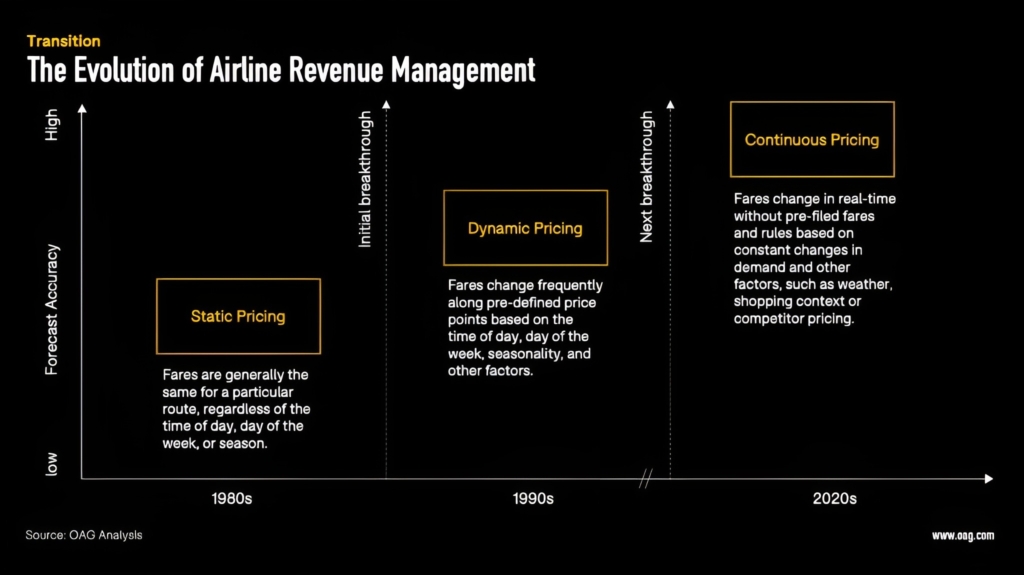
“Airline pricing has always been very traditional,” Varma says. “Now we are looking at NDC pricing, we are looking at dynamic and continuous pricing, which is really great for the business because you are not restricted to the old GDS pricing mechanisms.”
Once those constraints are loosened, AI becomes much more powerful. Instead of choosing between 20 or so fare levels, algorithms can recommend a price anywhere on the curve, using signals such as demand, capacity, seasonality, competitor moves and shopping data patterns.
Industry analyses suggest true dynamic strategies, backed by rich shopping data, can lift revenue by several percentage points above traditional revenue management methods.
Why airlines want AI in the pricing loop
If airlines can already price dynamically, why do they now need AI? In Varma’s view, it is about productivity and scale.
“Data is gold,” he says, “but airlines have so much data today that they do not know how to interrogate it.”
He describes how revenue and pricing teams are drowning in data: fares scraped from hundreds of airlines and OTAs, demand forecasts, search and shopping data, operational constraints and competitive benchmarks.
AirGain’s answer is to use AI to do the heavy lifting and flag what matters. Its Route Performance Digest, launched in March 2025, generates an AI-powered daily view of network performance, anomalies and opportunities, so revenue managers do not have to wade through endless reports.
Varma says customers such as Tigerair Taiwan and Sky Airline are already using these tools to spot route-leak gaps earlier and react more quickly to competitor moves.
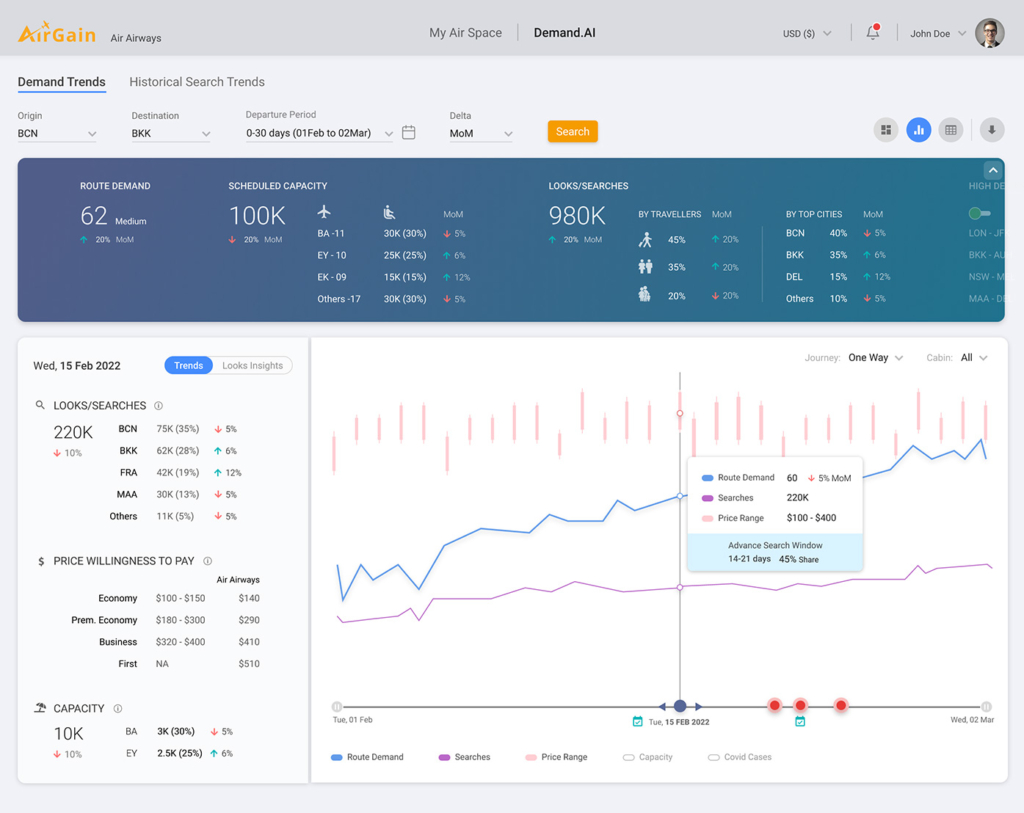
AirGain’s new AirGain View platform goes a step further, providing a single, visual interface that blends external data sources (airline sites, OTAs, metas) with AirGain’s own analytics and AI models.
“Our primary objective is to make the life of a revenue manager and a pricing manager easier,” Varma says. “Make them more productive, nudge them in the right way, to look at the right route, look at where they are competitive, not competitive, and really boost revenue.”
Crucially, he does not think AI replaces humans, at least not yet. AI agents, he says, automate “mundane jobs” such as routine price checks, anomaly detection and basic adjustments, while humans focus on strategy, underperforming routes and exceptions.
“We think there is still going to be a lot of human oversight,” Varma says. “In the long term, there is a huge possibility” of AI taking over more pricing interventions, but revenue managers are not being written out of the script yet.
Other carriers are moving the same way. Flair Airlines, for example, has deployed an AI module that continuously re-forecasts demand and optimises fares across its network, while still allowing revenue teams to overlay business rules.
That hybrid model, where AI manages the volume and humans set the guardrails, is becoming the dominant pattern.
2026 could be the year AI airline fare pricing explodes
Varma sees the next 12 to 18 months as an inflexion point. Over the last few years, airlines have invested heavily in NDC, offer and order systems, and shopping-data pipelines. Now that plumbing is in place, they are ready to scale the AI layer that sits on top.
RateGain is betting on that timing. Varma hints at an “industry-first AI roadmap” that the company plans to roll out in early 2026, focused on deeper automation of pricing decisions and richer external-data integration.

That roadmap will build on today’s digest-style tools and move toward AI systems that not only flag issues but also directly recommend, and eventually execute, fare changes within airline-defined limits.
Other vendors are pushing in the same direction, combining machine learning with real-time data processing and positioning AI as the engine of “true” dynamic pricing rather than a bolt-on optimisation layer.
Put simply, 2024 and 2025 were about proving concepts and replatforming. 2026 is when AI pricing starts to become embedded in day-to-day airline economics.
Will AI airfares be better or worse for passengers?
Mention “AI pricing” to a passenger, and suspicion is usually the first reaction. Is this about being rinsed for every penny?
Varma rejects the idea that AI will simply drive fares upward. The real shift, he says, is greater choice. “There’s definitely more choice,” he says. “Fixed price points go away with dynamic pricing and continuous pricing,” giving airlines far more room to fine-tune prices.
Instead of leaping between rigid fare buckets, AI allows prices to move in smaller, more responsive steps that reflect demand, capacity and competition. “You will always have the demand parameters… and what the competition is doing,” he notes, emphasising that AI works within market forces rather than against them.
The result is not uniformly higher or lower fares, but more granularity. As Varma puts it, “the consumer wins because there’s more choice,” with more personalised offers emerging as AI matures.
Marc-Philippe Lumpe at Air Transat goes further, arguing that AI can correct some of the industry’s own pricing mistakes. In traditional systems, he says, airlines often fail to notice when prices have been held too high for too long, leaving “spoiled seats” that go out empty because demand never materialised.
“If you have too high prices, at some point you are not able to really fill the seats anymore,” he told AGN. “If you can pick that up early enough, it is better to sell a seat at a lower price than not have it filled at all. You just do not want to do this too early, and that is why you sometimes end up with spoiled seats, because the price and the offer and the demand were not matched up early enough. That would not happen [with AI pricing], which means that you would see people actually having access to seats at lower prices as well.”
Passengers, he says, should not assume this only works in the airline’s favour. “People always think negatively, but they should not, because this mechanism can also work in the other direction.”
There are, however, legitimate concerns. Corporate-travel buyers and TMCs worry that AI-driven, highly personalised pricing could make it harder to benchmark “fair” fares, if suppliers present different prices to different customers or channels based on behaviour and context.
Regulators are also beginning to watch algorithmic pricing for transparency and potential discrimination in other sectors, and aviation will not be immune from that scrutiny.
The new normal for airline fare pricing
The direction of travel is clear. As more airlines embrace continuous pricing and AI-driven revenue tools, fare setting is becoming a high-frequency, data-rich discipline rather than a batch process tied to fare filings.
AirGain sees its role as helping airlines make sense of the mountain of data they already sit on, transforming it into clear, actionable insight and, over time, into pricing systems that can handle more of the routine work themselves. Airlines, in turn, hope this will translate into steady revenue gains, sharper reactions to competitors and fewer seats going out empty.
What it means for travellers is more nuanced. Fares will still climb when demand is high and capacity is stretched, but smarter systems should also reveal genuinely lower prices when airlines need to stimulate demand.
As AI becomes more embedded in pricing through 2026 and beyond, the real question is whether the industry can use it not just to improve margins, but to build a system that is easier to understand, more balanced and ultimately fairer for the people buying the tickets.
Leave a Reply