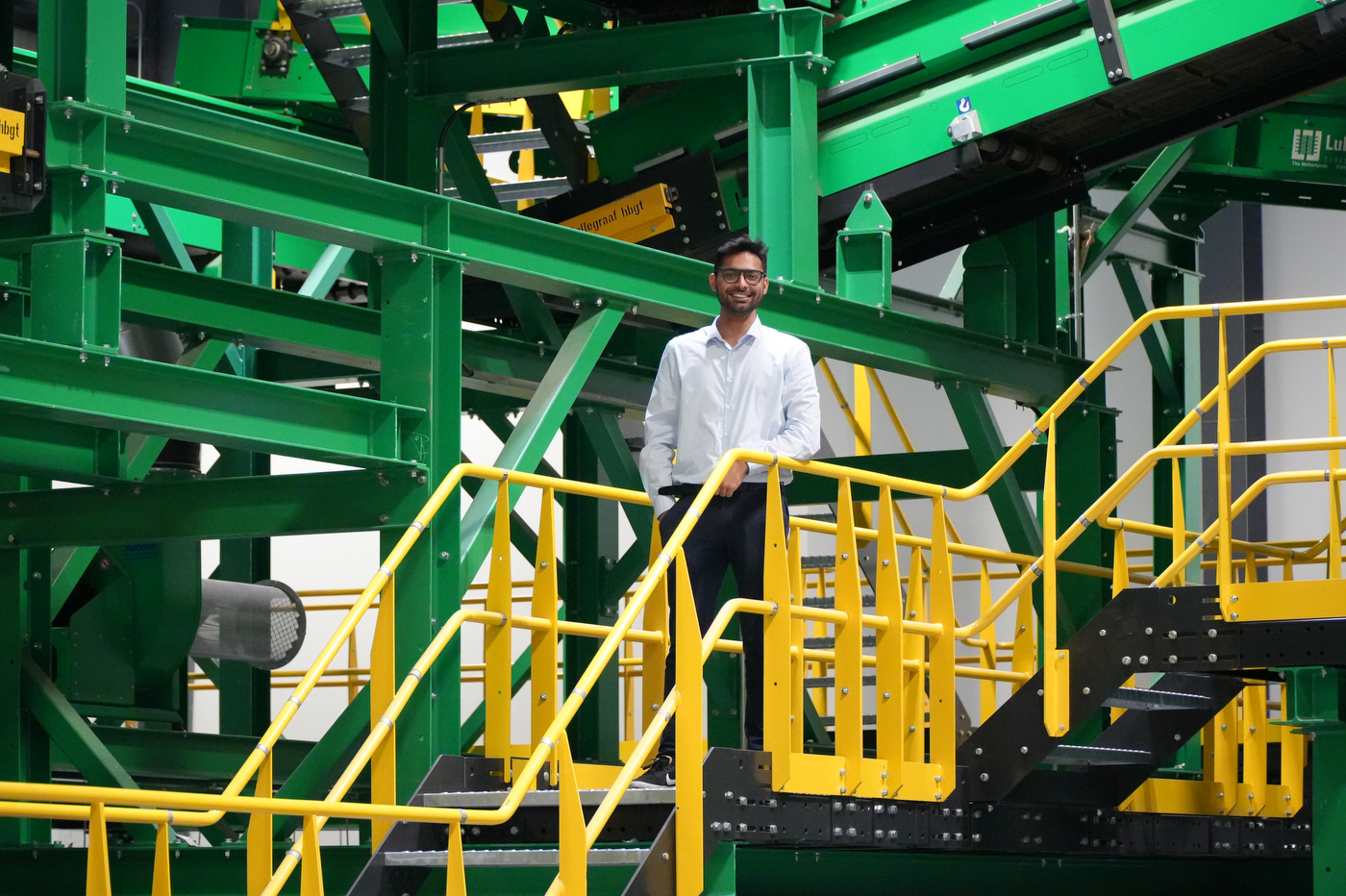
Most children will break their toys. At 4 years old, Ajith Srikanth wanted to fix his.
When he broke a small toy bicycle he had received, Srikanth was nervous to tell his parents. Scared that he might not get another, he resolved to repair it. With a little glue, he set the broken wheel and handlebars right. He got his toy back and a valuable lesson.
“My mom encouraged me to think like this: If you break stuff, try fixing it,” said Srikanth, now an engineering master’s degree student at Northeastern University working in advanced and intelligent manufacturing. “Then you will at least know the value of the effort that you put in, and in the process of fixing it you learn something. … After a failure, it’s not really a failure for me. I try to think of that failure as my lesson for the next goal or ambition that is going to come.”
Srikanth now fixes much more complicated things than a toy bicycle and uses much more advanced tools than glue. He’s using AI to revolutionize an industry that underlies almost every area of life: manufacturing. As a co-op at Van Dyk Recycling Solutions, a leading design, consulting and equipment provider for recycling facilities, Srikanth is pushing AI, and himself, into a new frontier.
“I have put my leg into a lot of boats, but the learning that I got and the exposure that I got from doing something like this is just phenomenal for me,” Srikanth said. “I just saw manufacturing as this one thing. Now I see manufacturing with AI, with recycling, with sustainability and it’s a lot more big picture.”
At Northeastern, Srikanth had designed a chatbot that would troubleshoot solutions that engineers encounter in manufacturing, like a broken sensor, conveyor belt or laser marking machine. That project earned him his co-op at Van Dyk, which wanted a similar chatbot for its own engineers.

“It helps people, especially service engineers, to gather information that is there in hundreds of manuals,” Srikanth said.
Srikanth finished that project in just two months and quickly started finding ways to integrate AI into nearly every part of Van Dyk’s operations.
As part of the chatbot, Srikanth also built a back-end piece of software that allows engineers who resolve their own hardware issues to submit a form detailing their solution. The idea is to create a more robust knowledge dataset that the chatbot can pull from when it offers people troubleshooting issues. Humans are still in the loop and are actually integral to the chatbot being able to operate effectively.
He developed a model that uses cameras to help Van Dyk’s recycling machines better distinguish and sort different kinds of waste like plastic, cardboard and glass. He even built a model that pulls from a database of over 1 million Van Dyk engineering documents to quickly identify a specific machine and its parts.
That might sound straightforward but it’s hugely impactful for Van Dyk, which has been around for 48 years and has machines that are just as old. Srikanth is still doing what he’s always done: fix things.
“That way you don’t scrap those machines; you can repair them, which saves time,” Srikanth said. “Now, they are refurbishing machines. That also saves the company the cost, it saves the environment.”
Ultimately, Srikanth designed 13 different AI-based models and systems for Van Dyk.
“AI has shifted us from reactive, manual work to proactive, automated operations,” said Faizan Jamal, an engineer at Van Dyk. “We now extract, classify, and validate data at scale, speeding up tasks like file matching, equipment tracking and document review. It’s changed how we design processes, pushing us to think in terms of automation, quality, and scalability, rather than manual effort or legacy workflows.”
Srikanth still sees AI as the future of manufacturing and a revolutionary force in our lives. However, his time at Van Dyk has also convinced him that knowing “when to stop using AI” is just as important as knowing when to use it.
“AI can only be used to help you, not build you stuff. Building stuff is upon your brain and how you compute it,” Srikanth said. “For me, and the company as well, AI is not going to take over your job. It is going to help make your job better. You need to know how to use AI to your benefit rather than one, not use it at all or two, use it so much that it costs your job.”
Leave a Reply