Stock Price Movement and Market Context
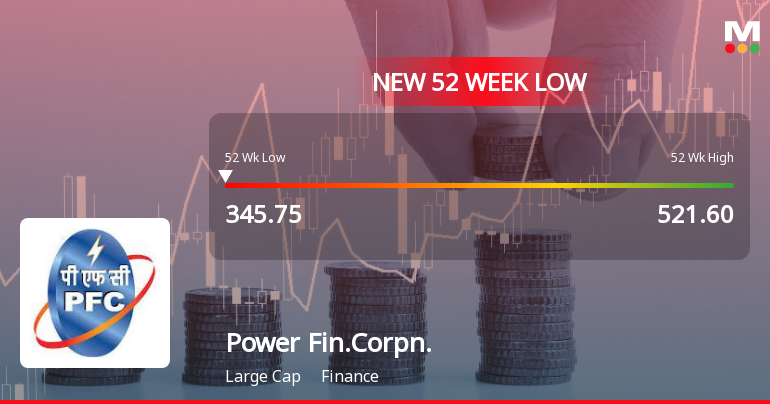
On 8 December 2025, Power Finance Corporation’s share price touched Rs.347.35, representing its lowest level in the past year. This decline follows two consecutive sessions of gains, signalling a reversal in short-term momentum. The stock underperformed its sector by 0.71% on the day, with a day change of -1.35%. Notably, the share price is trading below all key moving averages, including the 5-day, 20-day, 50-day, 100-day, and 200-day averages, indicating a sustained downward trend over multiple time horizons.
In contrast, the Sensex index opened flat but later declined by 223.66 points, or 0.36%, closing at 85,401.18. The benchmark remains within 0.89% of its 52-week high of 86,159.02 and is trading above its 50-day moving average, which itself is positioned above the 200-day moving average, reflecting an overall bullish trend in the broader market.
Comparative Performance Over One Year
Over the last twelve months, Power Finance Corporation’s stock price has recorded a negative return of 32.27%, a stark contrast to the Sensex’s positive return of 4.52% during the same period. This divergence highlights the stock’s relative underperformance within the finance sector and the broader market. While the BSE500 index has generated a modest return of 1.32% over the year, Power Finance Corporation’s shares have lagged considerably behind.
Financial Results and Profitability Metrics
Power Finance Corporation reported flat results for the quarter ending September 2025. The company’s profit after tax (PAT) stood at Rs.5,743.25 crore, reflecting a decline of 5.5% compared to the average of the previous four quarters. This contraction in quarterly profits contributes to the subdued market sentiment surrounding the stock.
Despite the recent profit contraction, the company’s profits over the past year have shown a rise of 16.8%, indicating some underlying earnings growth. The return on equity (ROE) is recorded at 19.5%, which suggests a reasonable level of profitability relative to shareholders’ equity. Additionally, the stock’s price-to-book value ratio is 0.9, placing it near fair valuation compared to historical averages and peer companies within the finance sector.
Dividend Yield and Institutional Holdings
At the current price level, Power Finance Corporation offers a dividend yield of 4.05%, which is relatively high and may appeal to income-focused investors. Institutional investors hold a significant stake in the company, accounting for 34.87% of the shareholding. This level of institutional ownership reflects the presence of investors with substantial resources and analytical capabilities monitoring the company’s fundamentals.
Valuation and Market Position
The stock’s price-to-earnings growth (PEG) ratio stands at 0.3, which is indicative of the relationship between the company’s earnings growth and its valuation. While the stock price has declined over the past year, the PEG ratio suggests that the valuation relative to earnings growth remains modest. This is consistent with the stock trading at a fair value compared to its peers’ historical valuations.
Summary of Key Market Indicators
Power Finance Corporation’s 52-week high price was Rs.521.60, which contrasts sharply with the current 52-week low of Rs.347.35. This wide price range over the year reflects significant volatility and market reassessment of the company’s prospects. The stock’s recent trading below all major moving averages further underscores the prevailing downward trend.
Meanwhile, the broader market, as represented by the Sensex, continues to demonstrate resilience, trading above its 50-day and 200-day moving averages and remaining close to its own 52-week high. This divergence between the stock and the benchmark index highlights the specific challenges faced by Power Finance Corporation within the finance sector.
Conclusion
Power Finance Corporation’s stock reaching a 52-week low of Rs.347.35 marks a notable development in its market performance. The decline follows a period of subdued quarterly profits and a year of relative underperformance compared to the broader market indices. While the company maintains a fair valuation and a solid dividend yield, the stock’s current price reflects a cautious market stance amid ongoing reassessment of its financial results and sector dynamics.
Limited Time Only! Upgrade now and get 1 Year of Stock of the week worth Rs. 14,999 for FREE. Don’t miss out on this exclusive offer. Claim Your Free Year →
Leave a Reply