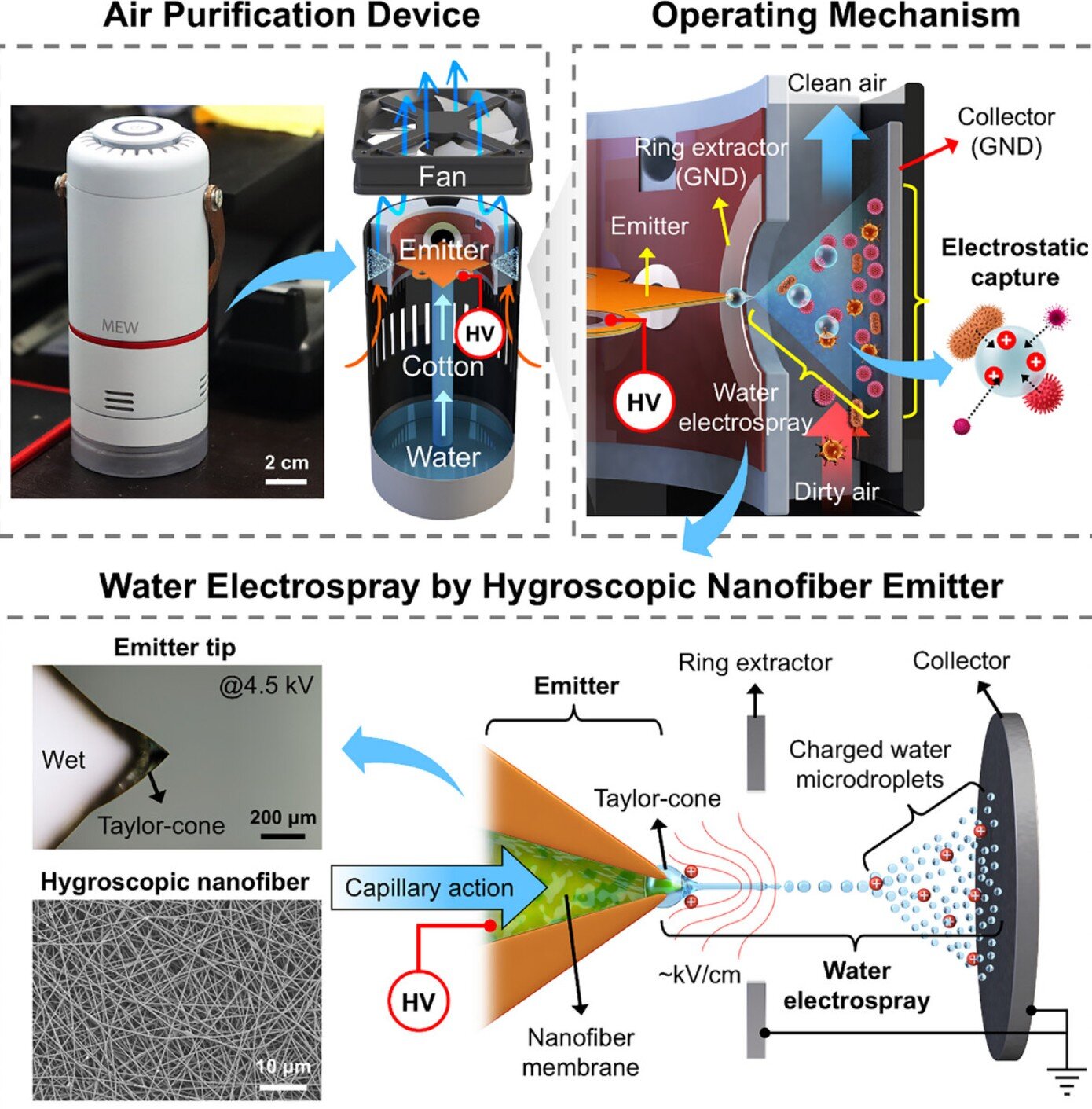

A KAIST research team has developed a new water-based air purification technology that combines nano water droplets that capture dust with a nano sponge structure that autonomously draws up water, enabling dust removal using nano water droplets without filters. It offers a self-supplied water operation with long-term, quiet, and safe performance.
A joint research team led by Professor Il-Doo Kim of the Department of Materials Science and Engineering and Professor Seung S. Lee of the Department of Mechanical Engineering developed the new water electrospray–based air purification device that rapidly removes ultrafine dust without filters, generates no ozone, and operates with ultra-low power consumption.
How the new device works
The research team confirmed that this device overcomes the limitations of conventional air purifiers by eliminating the need for filter replacement, producing no ozone, and removing even extremely fine ultrafine dust as small as PM0.3 (diameter 0.3 μm), which is about 1/200 the thickness of a human hair, within a short time. In addition, it demonstrated high stability and durability without performance degradation even during long-term use.
This device was created by combining Professor Seung S. Lee’s ozone-free water electrospray technology with Professor Il-Doo Kim’s hygroscopic nanofiber technology. The research results were published on November 14 in the journal Advanced Functional Materials.
Inside the device are a high-voltage electrode, a nanofiber absorber that autonomously draws up water, and polymer microchannels that transport water via capillary action. Due to the structure, a self-pumped configuration is achieved in which water is automatically supplied without a pump, enabling stable long-term water electrospray operation.

Performance and potential applications
Tests conducted by the research team in a 0.1 m³ experimental chamber showed that the device removed 99.9% of various particles in the PM0.3–PM10 range within 20 minutes. In particular, it exhibited outstanding performance by removing 97% of PM0.3 ultrafine dust—difficult to eliminate using conventional filter-based air purifiers—within just five minutes.
Even after 30 consecutive tests and 50 hours of continuous operation, the device operated stably without performance degradation, and its power consumption was approximately 1.3 W, which is lower than that of a smartphone charger and only about 1/20 that of conventional HEPA (High Efficiency Particulate Air) filter–based air purifiers.
In addition, because there is no filter, there is no pressure loss in airflow and almost no noise is generated.
This technology maintains high-efficiency purification performance while generating no ozone at all, presenting the potential for a next-generation eco-friendly air purification platform.
In particular, with advantages such as elimination of filter replacement costs, ultra-low power operation, and secured long-term stability, it is expected to expand into various fields including indoor environments as well as automotive, cleanroom, portable, and wearable air purification modules.
More information:
Jihwan Chae et al, Self‐Pumped Hygroscopic Nanofiber Emitter for Ozone‐Free Water Electrospray‐Based Air Purification, Advanced Functional Materials (2025). DOI: 10.1002/adfm.202523456
Citation:
Nano water droplet technology removes 99.9% of ultrafine dust in the air (2025, December 8)
retrieved 8 December 2025
from https://phys.org/news/2025-12-nano-droplet-technology-ultrafine-air.html
This document is subject to copyright. Apart from any fair dealing for the purpose of private study or research, no
part may be reproduced without the written permission. The content is provided for information purposes only.
Leave a Reply