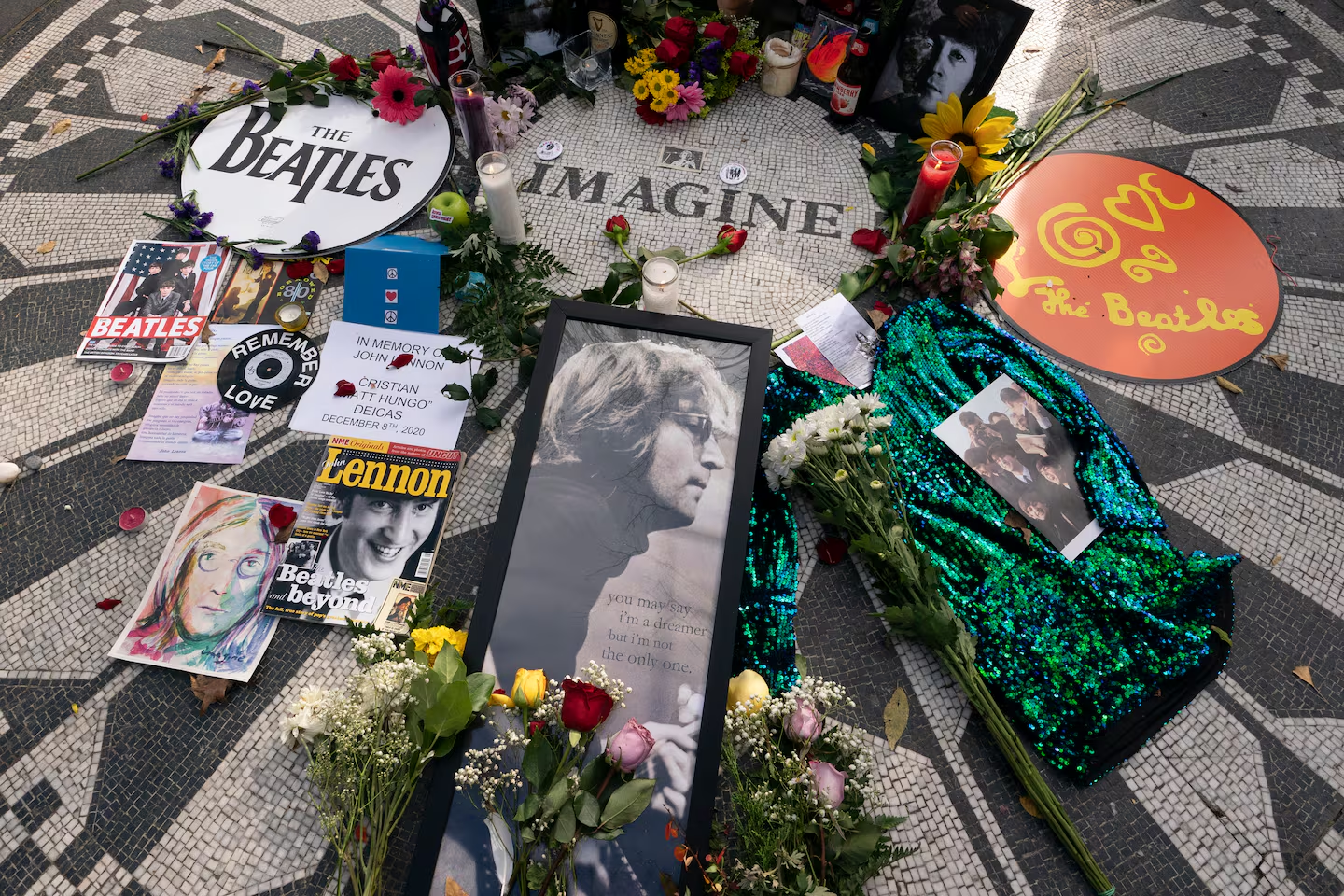
Millions of Americans were watching the Patriots and Dolphins on “Monday Night Football,” a humdrum game between two mediocre teams, when Howard Cosell delivered the news that still feels shocking 45 years later.
“Remember, this is just a football game, no matter who wins or loses,” Cosell said in his distinctive staccato just before 11 p.m. on Dec. 8, 1980. “John Lennon, outside of his apartment building on the West Side of New York City — the most famous, perhaps, of all the Beatles — shot twice in the back, rushed to Roosevelt Hospital, dead on arrival.”
It was an indelible TV moment, much like Walter Cronkite’s trembly, on-the-verge-of-tears announcement in 1963 that President John F. Kennedy had been assassinated in Dallas. Lennon, the world soon learned, had been shot four times in the back as he and wife Yoko Ono were walking into the Dakota, the historic Manhattan co-op where the couple lived with their 5-year-old son, Sean. (The killer, Mark David Chapman, is still in prison.)

News of Lennon’s murder was met with an avalanche of grief. In the days that followed, there was an anguished candlelight vigil in Los Angeles; a wordless tribute on the steps of the Lincoln Memorial; a gathering in Central Park attended by 225,000 mourners; and a six-hour celebration of Lennon’s life (including a 10-minute moment of silence) in the Beatles’ hometown of Liverpool.
Sales of Lennon and Ono’s just-released album, “Double Fantasy,” immediately soared (in spite of mostly lukewarm reviews), as did interest in the Beatles’ catalog, and radio stations across the United States, and up and down the dial, scrapped program schedules and played the Beatles and Lennon around the clock.
“I immediately put on WBCN and started recording cassettes,” says Cha-Chi Loprete, a longtime Boston DJ who was just a 23-year-old listener the night Lennon was shot. “My apartment at the time was a complete Beatles museum — Beatles memorabilia everywhere.

“I was devastated,” says Loprete, who got hired at WBCN the next year and has hosted a Beatles show on Boston radio since 1983. (The current incarnation, “Breakfast with the Beatles,” can be heard on Saturday mornings on WUMB.) “That night was one of the worst moments of my life, and I still remember it vividly.”
At the time of Lennon’s death — he’d turned 40 that fall — the Beatles had been broken up for a decade and, while not irrelevant, the band was certainly out of fashion, especially among younger music fans. David Quantick, an English critic and comedy writer who’s written extensively about the Beatles (including a play about Lennon), recalls being ridiculed for enjoying the Fab Four.
“When I was at school, round about 1978, I had friends who would mock me,” Quantick says. “It was the age of punk and new wave, and liking the Beatles was like liking Fred Astaire.”

David Hepworth, a veteran British music writer and podcaster, said the outpouring of emotion that followed Lennon’s death had very little to do with Lennon himself.
“Rock stars are fantasy friends you acquire at the age of 12 and, in some cases, they’re still there in your 70s,” says Hepworth, who, at 75, is old enough to remember when John, Paul, George, and Ringo were a real-life rock ’n’ roll band, not a myth or distant memory. “You meet many people today who say it was only when John Lennon died that they realized he’d been in a group with that bloke from Wings.”
In the 45 years since that chaotic night outside the Dakota, the popularity of the Beatles has waxed and waned. But since the release in 2021 of “The Beatles: Get Back,” Peter Jackson’s acclaimed eight-hour docuseries, there’s been, it seems, an unquenchable appetite for all things Beatles. Lately, that has included the newly updated nine-hour Beatles documentary “Anthology” (available on Disney+); the stellar “One to One: John & Yoko” documentary (on HBO Max), focused on the 18 months the couple spent living in a basement apartment in the West Village; and whatever it is you call director Sam Mendes’s current project: four separate Beatles biopics to be released in theaters in April 2028.

For some, though, like Jude Southerland Kessler, the fascination with the Beatles — and Lennon, in particular — has never ebbed. Kessler, who lives in Louisiana, is to John Lennon what Robert Caro is to Lyndon Johnson. She’s spent the past 40 years researching and writing what, eventually, will be a 10-volume narrative of Lennon’s life. She’d hoped to get the job done in nine volumes — a nod to “number 9, number 9…” from the Beatles song “Revolution 9” — but the fifth book, covering the band’s whereabouts in 1965, ran to 1,600 pages.
“When I got to page 800 and the boys were only in August, I knew I was going to have to break it up,” Kessler says. “It’s really a landmark year for them.”
On the 45th anniversary of Lennon’s death, Kessler said she has no plans. But she did the night he was shot. An English teacher at the time, Kessler was at home getting ready to see her husband, a Navy officer who was due to return the next day from a long deployment overseas.
“I had a brand new dress laid out on the bed. I cleaned the house and had fresh flowers,” she says. “Then a friend of mine called and said, ‘I need you to sit down.’”
Mark Shanahan can be reached at mark.shanahan@globe.com. Follow him @MarkAShanahan.
Leave a Reply