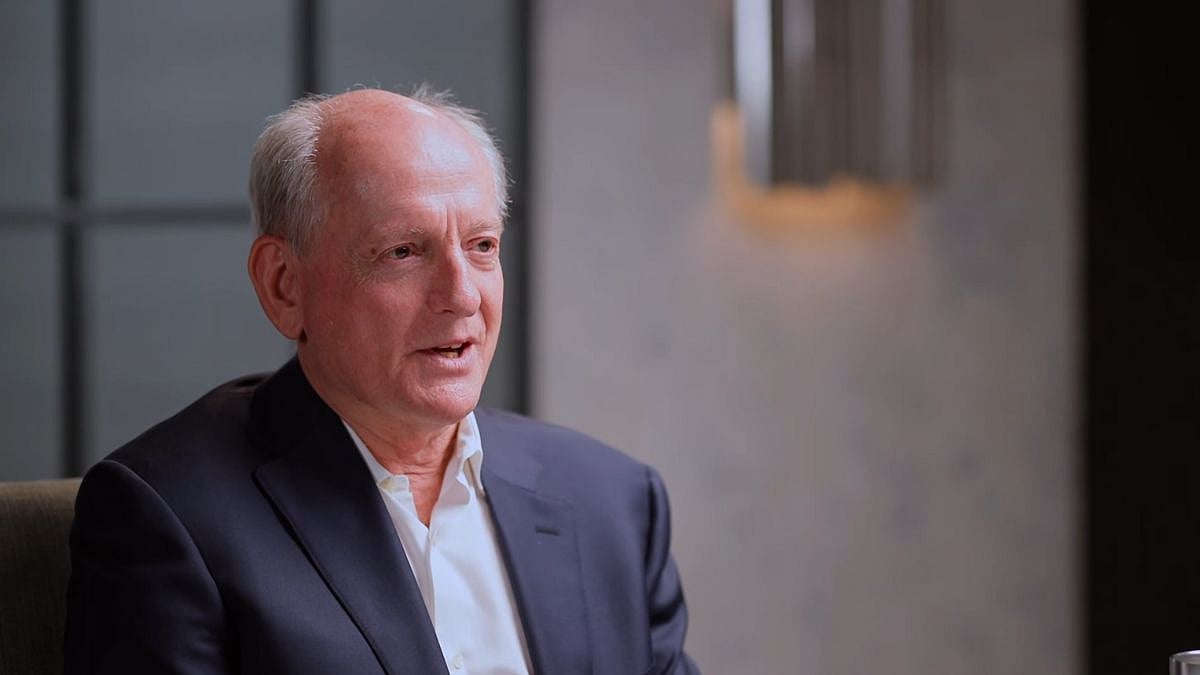
While tech layoffs are already underway, with employees getting laid off in big numbers, an AI expert says that this may only be the beginning. Professor Stuart Russell claims that AI could eventually automate up to around 80 percent of existing jobs, affecting not only routine or junior roles but also highly paid professionals and even CEOs. Russel made this claims in his latest interview with Steven Bartlett on The Diary of a CEO podcast.
Russell asserted that AI systems are already encroaching on ‘pretty much everything we currently call work’. He foresaw a scenario where automation accelerates to the point that ‘suddenly, they’re staring, you know, 80 percent unemployment in the face and wondering how on earth is our society going to hold together’. He frames this as a looming economic and social crisis, and says governments are not preparing adequately for that level of disruption.
He draws parallels to historical technological shifts like the Industrial Revolution, or the invention of nuclear weapons. Unlike the gradual mechanisation of factories, AI could embed itself into knowledge-based and creative roles almost overnight, hollowing out the global workforce without adequate time for adaptation. He highlighted how even the largest employers, such as Amazon, are poised to replace hundreds of thousands of roles with robots, shrinking corporate headcounts in favour of algorithmic efficiency.
A world without work: Russell’s dire prediction
Drawing parallels to historical technological shifts like the Industrial Revolution, Russell cautioned that the pace of AI advancement outstrips past disruptions. Unlike the gradual mechanisation of factories, AI could embed itself into knowledge-based and creative roles almost overnight, hollowing out the global workforce without adequate time for adaptation. He highlighted how even the largest employers, such as Amazon, are poised to replace hundreds of thousands of roles with robots, shrinking corporate headcounts in favour of algorithmic efficiency.
No profession spared: From surgeons to coders
Russell’s analysis spares no sector, underscoring the vulnerability of highly skilled trades. He vividly illustrated the threat to medicine by noting that a robot could master surgical techniques ‘in seven seconds’ and surpass any human practitioner, potentially wielding tools with millimetre precision unattainable by flesh-and-blood hands. Coders, too, face obsolescence as AI generates and debugs software with superhuman speed, while routine white-collar tasks – from data analysis to report drafting – dissolve into automated routines.
Even the creative and interpersonal realms are not immune. Russell evoked Elon Musk’s recent assertion that humanoid robots will eclipse the finest surgeons by a factor of ten, signalling a broader automation of aspirational careers.
Even CEOs may not be immune to AI layoffs
In a particularly provocative segment, Russell turned his gaze to the executive suite, predicting that chief executives themselves could fall victim to their own innovations. “Pity the poor CEO whose board says, ‘Well, you know, unless you turn over your decision-making power to the AI system, um, we’re going to have to fire you,’” he quipped, envisaging a corporate Darwinism where AI-augmented rivals outpace human-led firms.
He urged governments to overhaul education and economic models, from universal basic income to retraining programmes, though he acknowledged the decades required for such transitions.
Who is Stuart Russell?
For those unaware, Russell has been involved in researching about AI since many years, and is a world-renowned Computer Science Professor at UC Berkeley. He holds the Smith-Zadeh Chair in Engineering and directs the Center for Human-Compatible AI, and is also the bestselling author of the book ‘Human Compatible: AI and the Problem of Control’. He has also been awarded as the ‘most influential person in AI’ by Times magazine multiple years in a row.
Leave a Reply