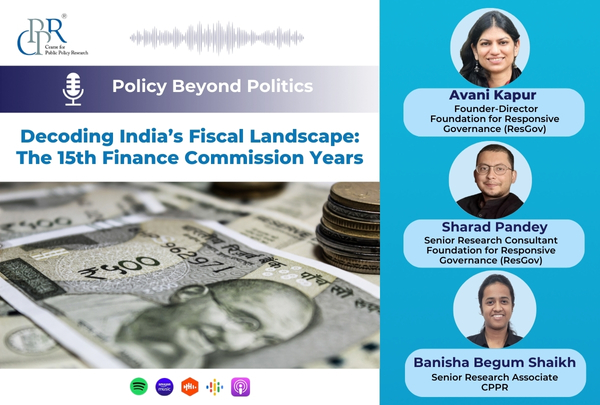

Decoding India’s Fiscal Landscape: The 15th Finance Commission Years
Introduction
As India stands on the brink of the XVI Finance Commission’s recommendations, the debate on fiscal federalism has re-emerged at the centre of public policy discourse. A recent report titled “State Finances in Transition: An Analysis of Revenue Receipts and Fiscal Dynamics in India During the XV Finance Commission Period”, published by the Foundation for Responsive Governance and authored by Sharad Pandey and Avani Kapur, provides an in-depth examination of the receipts side: the sources, structure, and trends in own revenues, tax devolution, grants-in-aid, and borrowings. It documents the persistent divides across regions and economic strata and examines the implications of recent reforms on state fiscal autonomy.
As we reflect on these fiscal themes, this episode places the discussion within the broader context of the 15th Finance Commission Years, highlighting how its recommendations continue to shape India’s evolving fiscal architecture.
Rationale
The original intent of fiscal federalism in India was to create a balance between national unity and regional autonomy. The Finance Commission was designed to serve as a neutral arbiter, ensuring equitable distribution of financial resources and preserving states’ fiscal space to pursue independent development strategies — a vision that is particularly relevant when analysing the 15th Finance Commission Years.
However, the current fiscal landscape presents a more complex reality:
-
States face increasing dependence on the Union, with cesses and surcharges increasingly bypassing the divisible pool.
-
The Goods and Services Tax (GST) has narrowed the states’ tax base and heightened reliance on central transfers.
-
The discontinuation of the GST compensation cess and conditional grant structures have further constrained fiscal autonomy.
-
The North–South fiscal divide and population-based devolution formula continue to fuel the equity–efficiency debate.
As Pandey and Kapur’s research report illustrates, India’s fiscal federalism is now at a crossroads—caught between the ideals of fiscal decentralization and the realities of increasing centralization. This podcast aims to unpack these tensions and explore whether the constitutional vision of fiscal balance, as tested during the 15th Finance Commission Years, can be reimagined for the future.
About the Podcast:
This episode of the Policy Beyond Politics (Market Series) podcast will be a discussion of the research report titled “State Finances in Transition: An Analysis of Revenue Receipts and Fiscal Dynamics in India During the XV Finance Commission Period,” published by the Foundation for Responsive Governance (ResGov) and authored by Sharad Pandey and Avani Kapur.
Tune in for an insightful discussion on revenue receipts and fiscal dynamics in India during the XV Finance Commission period.
KEY DISCUSSION POINTS
- India’s performance during the XV Finance Commission period, and major trends that emerged across key fiscal indicators
- Realistic ONTR avenues states can explore without undermining the equity or affordability of public services
- Key drivers of actual tax devolution during the XV Finance Commission period, which exceeded the amounts originally recommended
- Measures to be prioritised to strengthen the states’ receipt side of the balance sheet under the 16th Finance Commission, since borrowings continue to constitute a significant share of total state receipts
Speakers:
Avani Kapur, Founder and Director, Foundation for Responsive Governance (ResGov), New Delhi
Sharad Pandey, Senior Research Consultant, Foundation for Responsive Governance (ResGov), New Delhi
Host:
Banisha Begum Shaikh, Senior Associate – Research & Projects, Centre for Public Policy Research (CPPR), Kerala
#PolicyBeyondPolitics is available on
Leave a Reply