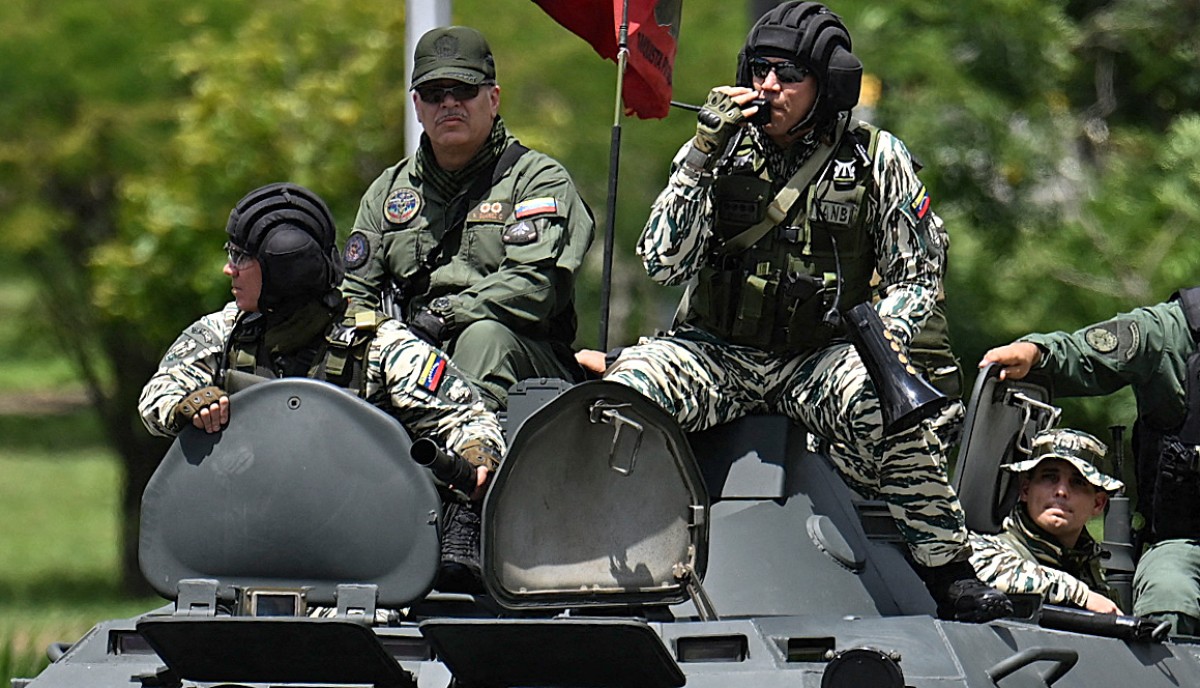
The Venezuelan armed forces inducted 5,600 new soldiers on Saturday at the sprawling Fuerte Tiuna military base in Caracas, the nation’s largest such complex.
The ceremony unfolded against a backdrop of heightened tensions with the United States, which has amassed an unprecedented naval armada in the Caribbean, including the USS Gerald R. Ford – the world’s largest aircraft carrier – alongside a flotilla of destroyers and submarines.
This buildup, the most significant U.S. military deployment in Latin America in decades, has sparked widespread speculation about potential escalation, from covert operations to a possible attack on the country.
President Nicolás Maduro, facing accusations from Washington of presiding over a narco-state, has intensified recruitment drives to fortify the country’s defenses.
Official data indicates that Venezuela maintains an active-duty force of approximately 200,000 troops, supplemented by another 200,000 police personnel, amid ongoing economic strains and political unrest.
The event, attended by high-ranking officers and government loyalists, highlighted Maduro’s narrative of external threats undermining the nation’s sovereignty.
“Under no circumstances will we allow an invasion by an imperialist force,” Colonel Gabriel Rendón said during the swearing-in ceremony, echoing the government’s defiant stance.
The United States says it is fighting drug trafficking. Since late November, U.S. ships and aircraft have attacked more than 20 speedboats that they believe were carrying drugs. These attacks have killed at least 87 people. Washington says the boats belong to drug networks run by top officials in the Venezuelan government.
The Trump administration has designated the so-called “Cartel of the Suns” – purportedly involving Maduro’s inner circle – as a terrorist entity, though critics note Washington has yet to release concrete evidence.
Maduro, in turn, slams the deployments as a pretext for regime change and resource grabs, eyeing Venezuela’s vast oil reserves, the world’s largest proven deposits.
This deployment follows a disputed July 2024 election, in which Maduro secured a third term amid allegations of fraud from opposition groups and international observers.
The ensuing protests claimed 28 lives and led to roughly 2,400 detentions, with nearly 2,000 individuals since released under amnesty measures.
Yet, the specter of repression lingers, as evidenced by Saturday’s tragic death of former opposition governor Alfredo Díaz in custody.
The 55-year-old Acción Democrática leader who governed Nueva Esparta state from 2017 to 2021 succumbed in the notorious El Helicoide prison – a facility long decried as a hub for torture and isolation by human rights watchdogs.
Detained on terrorism and incitement charges post-election, he marks the sixth opposition figure to perish in detention since November 2024, according to Foro Penal, a Caracas-based NGO advocating for political prisoners.
Díaz had endured a year of solitary confinement, permitted just one visit from his daughter, and reportedly denied timely medical care, with authorities citing a heart attack as the cause of death.
“He had been imprisoned and held in isolation for a year; only one visit from his daughter was allowed,” said Alfredo Romero, director of Foro Penal, which documents at least 887 political prisoners nationwide.
The group has demanded an independent autopsy and holds the state accountable for his welfare. The loss has ignited outrage among dissidents.
Opposition heavyweight María Corina Machado, the Nobel Peace Prize laureate living in hiding, decried the fatalities as emblematic of systemic abuse.
“The circumstances of these deaths – which include denial of medical care, inhumane conditions, isolation, torture, cruel, inhuman and degrading treatment – reveal a sustained pattern of state repression,” Machado stated jointly with Edmundo González Urrutia, the U.S.-backed candidate she champions as the legitimate election victor.
Machado, set to receive her Nobel in Oslo this week, has vowed to amplify these voices on the global stage, drawing parallels to broader authoritarian crackdowns.
International condemnation has swelled, with Foro Penal’s reports fueling calls from the United Nations and European Parliament for investigations. Venezuelan officials counter that detainees receive due process, dismissing foreign critiques as biased meddling.

Diplomatic Lifelines
Meanwhile, Turkish President Recep Tayyip Erdoğan reached out to Maduro via phone on Saturday, advocating restraint amid fears of U.S. strikes.
Turkey, one of Maduro’s few steadfast allies since the 2018 election debacle, has deepened economic and political bonds, including gold trades and aviation links now disrupted by sanctions.
“It is important to keep channels of dialogue open between the US and Venezuela,” Erdoğan conveyed, per a readout from his office posted on X, expressing optimism that “the tension will ease as soon as possible.”
He affirmed Turkey’s vigilant monitoring of regional dynamics, insisting “problems can be solved through dialogue.”
Venezuela’s foreign ministry echoed the exchange, citing Erdoğan’s “deep concern over the threats facing Venezuela, particularly the military deployment and various actions aimed at disrupting peace and security in the Caribbean.”
Maduro reportedly detailed the “illegal, disproportionate, unnecessary, and even extravagant nature of these threats,” while both leaders lamented the suspension of direct flights following Trump’s November declaration deeming Venezuelan airspace “closed” – a move stranding millions of expatriates during the holiday season.
Erdoğan’s outreach revives speculation that Turkey could serve as a potential exile haven for Maduro should the American pressure mount.
U.S. media and figures like Senator Lindsey Graham have floated the idea, with Graham quipping on X last week: “I hear Turkey and Iran are lovely this time of year.” Erdoğan, who hosted Maduro in 2018, has rebuffed such notions, emphasizing bilateral solidarity.
The U.S. escalation, greenlit by Defense Secretary Pete Hegseth, has ignited domestic unease in Venezuela, where daily life masks simmering dread. Families stockpile essentials, and Christmas gatherings falter with flight bans, exacerbating the exodus of nearly eight million Venezuelans abroad.
Protests in U.S. cities like Sacramento decry the strikes as veiled warfare, while Venezuelan rallies chant “No war, yes peace.”
Analysts warn of ripple effects: heightened migration, disrupted oil markets, and proxy influences from Russia and China, who eye Venezuelan coastal footholds.
With Inputs from AFP
Leave a Reply