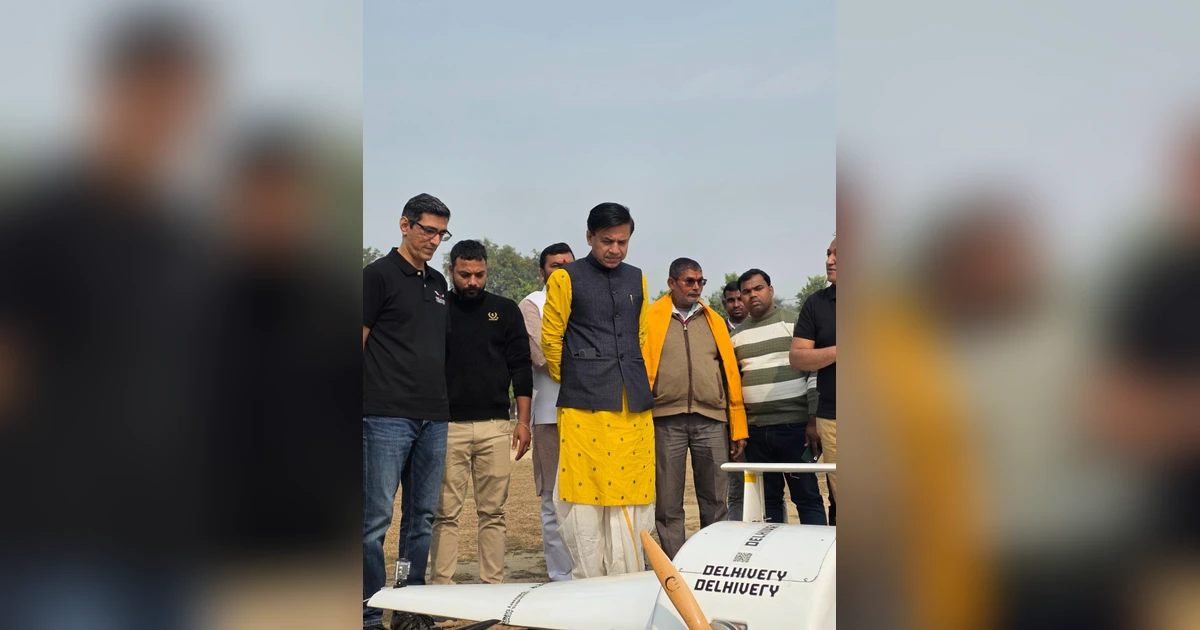
Logistics services provider Delhivery on Sunday said it has completed testing of its autonomous vertical take-off and landing (VTOL) drone technology in Deoria, Uttar Pradesh. During a live demonstration, a Delhivery drone carrying medicines completed a pre-programmed 12-kilometre (km) flight path autonomously in about 12 minutes.
“The mission, which would typically take up to 40 minutes by road due to infrastructure challenges, was completed in approximately 12 minutes, highlighting the potential of aerial logistics to transform last-mile delivery in India,” the company said in a statement.
The showcase, held in the presence of Shashank Mani, the Member of Parliament from Deoria, was executed by Delhivery Robotics India Private Limited, a subsidiary of Delhivery. The company is designing and manufacturing logistics drones.
The drone showcased is part of Delhivery’s prototype drone fleet, which is being developed using proprietary technology and is designed to operate in challenging terrain and weather conditions. It is capable of carrying payloads of up to 5 kilograms (kg) over distances of 60-90 km on a single charge.
What makes Delhivery’s VTOL drone different from conventional drones?
The company said the aircraft features a hybrid design, taking off vertically like a helicopter and flying horizontally like a plane for maximum efficiency. It added that a new platform with a payload capacity of up to 20 kg, as well as significantly indigenised content, is under development and slated to be launched in the future.
“Our technology is built for the realities of Indian geography. The ability to bypass traffic and road infrastructure allows us to turn ‘next-day’ delivery into ‘next-hour’ delivery for urgent shipments. Deoria was chosen for this pilot because it represents the perfect use case — a growing urban centre serving a vast, often inaccessible rural population,” said Nikhil Ummat, head of engineering at Delhivery.
How could drone logistics affect jobs and Delhivery’s network?
Delhivery highlighted job creation potential in the sector, emphasising that the drone ecosystem will require skilled pilots, maintenance engineers and ground operations staff, creating a new layer of high-skill employment in Tier-II and Tier-III cities.
The company’s nationwide network covers over 18,850 pin codes and it has over 48,000 customers, including large and small e-commerce participants, small and medium enterprises and other brands.
Leave a Reply