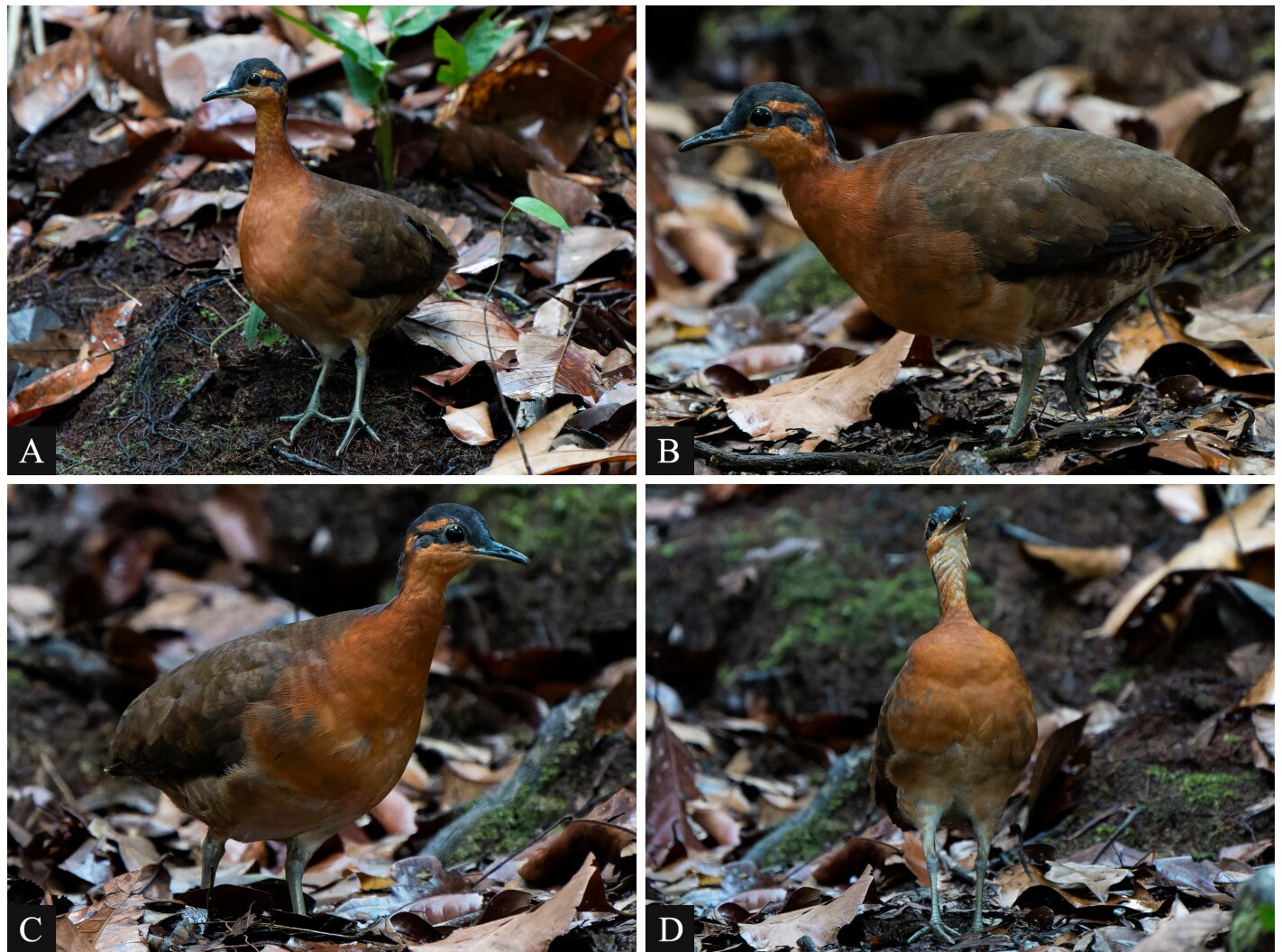

The Amazon rainforest has yielded yet another new species, according to a recent study published in Zootaxa. Discovered in the mountains of the Serra do Divisor National Park (SDNP) in Brazil, this ground-dwelling bird has been identified by a research team as a new species of Tinamus, a genus of birds in the Tinamou family Tinamidae.
The team says this new species has some pretty unique features, and has only been found in a narrow elevational band in the Serra do Divisor—potentially putting it at risk in the near future.
An unusual acoustic phenomenon
In October of 2021, a member of the research team first recorded the song of the undiscovered bird—which they describe as “an unusual acoustic phenomenon,” in which the bird’s vocalization diffused with the forest understory, creating a confused perception of the sound’s distance and direction. They noted similarities to the songs of other Tinamus, but it did not fit any particular species precisely.
Over the next few years, the team heard the song several additional times, but the dense vegetation, steep terrain and echoing nature of the sound made it difficult to find its source. It was not until November of 2024 that they finally identified the musician by luring it with recordings of its own song. The culprit was a mostly flightless bird with a unique dark slate-colored facial mask and cinnamon-colored underparts that was surprisingly unafraid of the curious humans.
“When confronted directly, individuals showed no avoidance behavior and appeared remarkably tame, seemingly failing to recognize humans as potential predators. In addition, individuals were observed crossing open areas of understory slowly and without signs of vigilance, a behavior contrasting with the typically wary responses of other tinamous,” write the study authors.
The researchers recognized that the bird was a previously undiscovered species, which they aptly named “Tinamus resonans”—resonans, from the verb resonare, meaning sounding back, echoing, or resounding.

A small population in a limited space
With further study of the new species, the research team found that they were mostly restricted to a narrow part of the forest.
“The species was observed exclusively on the steep forest floor within a narrow transitional zone between 310 and 435 meters a.s.l., representing a gradient between submontane and stunted forest. This habitat is characterized by an exceptionally dense and widespread mat of fine roots and leaf litter, forming a continuous network over nutrient-poor, quartzitic sandstone soil, through which the tinamou moves and forages,” the study authors explain.
Although the team only observed a total of 15 individuals, they used spatial analysis and habitat modeling with GIS tools to determine a population estimate of around 2100. All of the individuals collected for study were female, and it was unclear whether other observed individuals were male or female, as some Tinamus species have similar plumage in both males and females.
The researchers note, “The absence of males in the type series may be attributed to the behavioral ecology of Tinamus species, in which females tend to be the dominant sex and are primarily responsible for territorial defense. Consequently, females are more likely to approach playback, potentially resulting in a sampling bias favoring the collection of females.”
Looming threats
Although the habitat of the Tinamus resonans is currently within the limits of a national park, this may soon change. According to the study authors, the SDNP currently faces serious threats of being downgraded from a national park to an “Environmental Protection Area,” which actually has less protection from human activity. There are currently plans for construction of roads, railways, and mining activities in the area.
The combination of a small population, an at-risk habitat, and a lack of fear for humans put the Tinamus resonans at a high risk for extinction. Some have even likened their situation to that of the dodo bird, which quickly went extinct after humans came to the island of Mauritius.
The study authors encourage conservation, not only for the island of Tinamus resonans, but for the SDNP as a whole. They say focusing on ecotourism can facilitate conservation and also provide a source of income for the region.
Written for you by our author Krystal Kasal, edited by Gaby Clark, and fact-checked and reviewed by Robert Egan—this article is the result of careful human work. We rely on readers like you to keep independent science journalism alive.
If this reporting matters to you,
please consider a donation (especially monthly).
You’ll get an ad-free account as a thank-you.
More information:
Luis A. Morais et al, A new species of Tinamus (Aves: Tinamiformes) from the western Amazon, Brazil, Zootaxa (2025). DOI: 10.11646/zootaxa.5725.2.6
© 2025 Science X Network
Citation:
New ‘remarkably tame’ tinamou species discovered in Amazon mountains may already be at risk of extinction (2025, December 6)
retrieved 7 December 2025
from https://phys.org/news/2025-12-remarkably-tinamou-species-amazon-mountains.html
This document is subject to copyright. Apart from any fair dealing for the purpose of private study or research, no
part may be reproduced without the written permission. The content is provided for information purposes only.
Leave a Reply