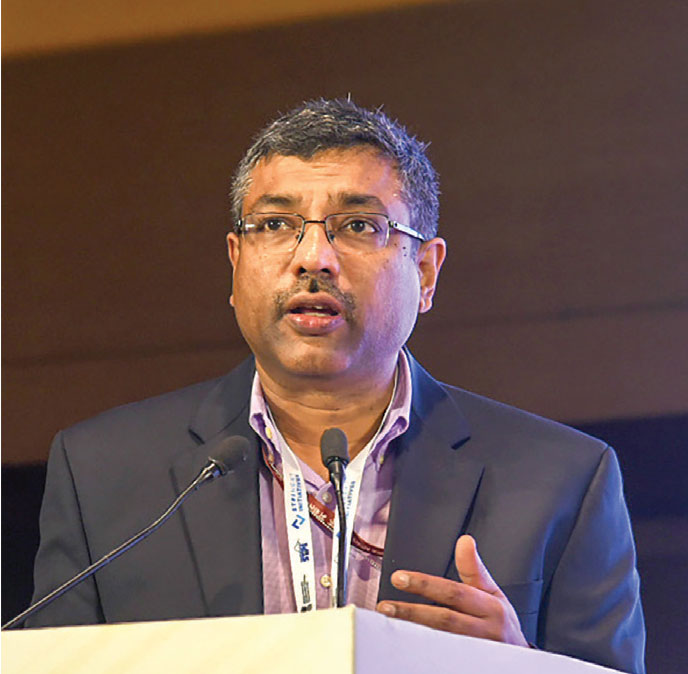

S. Krishnan, Secretary, Ministry of Electronics and Information Technology
Artificial intelligence (AI) is reshaping various sectors, ranging from health and education to agriculture and smart cities, and India has emerged as a key driver of this technology-led social and developmental shift. The growing integration of AI, emerging technologies, digital public goods, open-source platforms and data-driven governance tools is now central to advancing the sustainable development goals. Speaking at an industry event organised by the Observer Research Foundation in partnership with the Consulate General of India, the United Nations in India, and the Reliance Foundation, S. Krishnan, Secretary, Ministry of Electronics and Information Technology, emphasised the transformative potential of AI in shaping inclusive and sustainable progress in India. Edited excerpts from his address…
Changing landscape
Technology has always shaped the trajectory of global development. Every major wave of economic growth has been sparked by a shift in technological capability, and AI represents the next decisive moment. Unlike earlier technological transitions that influenced specific sectors, AI cuts horizontally across every part of the economy, touching education, healthcare, agriculture, manufacturing, governance and public services. For countries in the Global South, including India, this moment carries particular urgency. It may be the last window to achieve broad-based and lasting prosperity before demographic transitions begin to limit growth. That is why India chose to anchor the fourth AI summit around the idea of measurable, visible impact.
India’s leadership has emphasised that the next phase of AI must be about delivering results, not just discussing possibilities. The global conversation has matured quickly, moving from broad debates about risks and opportunities to a sharper focus on what AI can tangibly achieve. As the technology evolves and becomes more accessible, the expectation now is to translate its potential into real, measurable impact. What once demanded vast compute power, enormous capital and specialised infrastructure can now be deployed far more efficiently. At the same time, a significant portion of generative AI use still goes into trivial or entertainment-focused tasks rather than solving real development challenges. Redirecting this power towards areas where it can genuinely improve productivity and quality of life is essential.
India’s approach centres on using AI to unlock improvements where they matter most. Rather than overwhelming investment or large-scale spending, the strategy is built around frugal innovation, that is, identifying specific, high-impact opportunities and executing them effectively. This principle guides the focus on improving efficiency and outcomes in essential sectors while ensuring that no community or country gets left behind.
Making AI work
AI’s potential to transform key sectors is clear. In healthcare, it can help strengthen diagnosis, optimise resource allocation and support better patient outcomes. In agriculture, it can enhance productivity, help predict risks and assist farmers with timely information. In education, AI-driven tools have the potential to personalise learning at scale. In manufacturing, it can improve efficiency, streamline workflows and support more resilient systems. India’s strategy recognises this broad canvas and aims to apply AI where it can drive genuine improvements rather than symbolic projects.
Inclusion is at the heart of this approach. The country aims to ensure that the benefits of AI reach everyone. This includes using AI to support underserved regions, bridging digital gaps and making systems more accessible across communities. Beyond national boundaries, the idea extends to sharing solutions with the Global South, where many countries face similar developmental challenges.
India’s progress in building strong digital public infrastructure has made this possible. Over the past decade, the country has established platforms that enable digital identity, payments, data exchange and service delivery at population scale. These systems are now being extended to support AI-driven solutions. The presence of an AI-ready workforce has further strengthened this foundation. India currently ranks highest in AI skill penetration in the Stanford AI Index, and its data-driven governance framework has helped ministries and public agencies adopt technology effectively.
Building an AI ecosystem
India now hosts the world’s third largest start-up ecosystem, led primarily by private sector innovators eager to build new solutions. This ecosystem forms the backbone of the IndiaAI Mission, which is designed to bring together public purpose and private capability. A key element of this mission is the creation of AI compute infrastructure, not through direct public spending, but through a market-driven model.
Instead of setting up a single government-owned compute facility, India encouraged private companies to invest in building graphics processing unit (GPU) capacity. The government committed to purchasing compute at a competitive rate of about 78 cents per hour, roughly half the price of what is available globally. This assurance enabled private firms to establish nearly 38,000 GPUs within a year. The model is both sustainable and replicable for other countries in the Global South because it avoids the burden of large upfront public investment.
Alongside compute capacity, the national data sets platform has expanded rapidly and now includes more than 2,000 data sets. These data sets provide a crucial foundation for training and testing AI systems across sectors. India is also developing sovereign foundational models tailored to the country’s needs. One of the smaller foundational models under development focuses specifically on medical diagnostics using electroencephalography and X-rays. Such a model can help predict potential health issues earlier and with greater accuracy.
India’s linguistic diversity adds another dimension. With 22 official languages and many more spoken across various regions, ensuring that AI understands and incorporates knowledge from every language is essential. The models and applications being developed aim to capture this richness, making AI accessible and meaningful to all communities.
India sees the possibility of becoming the world’s leading hub for AI applications. This is where real deployment takes place, where solutions address everyday needs, and where governance systems can become more effective and responsive. It is also where employment opportunities expand. Deploying AI solutions requires people to configure models, implement systems, work with data and maintain applications, creating jobs for the youth in India and beyond.
People and governance
For AI to reach its potential, the workforce must be ready. Skilling is, therefore, a major pillar of the IndiaAI Mission. Training covers the entire spectrum, including basic awareness of what AI is and what it can do, intermediate skills like data annotation and data set creation, and advanced research capabilities for those pursuing higher studies. Because AI touches every sector, this broad-based approach ensures that people at all levels can participate in and benefit from the technology.
India’s approach to AI governance balances innovation with safety. The goal is to create a trusted and secure environment for AI adoption without slowing progress. The country already has laws that address issues such as deepfakes and digital misrepresentation. The data protection law ensures individuals have control over their personal data and how it is used. The government remains ready to legislate further if needed, but current efforts focus on enabling innovation rather than restricting it.
This combination of targeted investment, inclusive design, strong infrastructure and thoughtful governance forms the foundation of the IndiaAI Mission. It is increasingly seen by development agencies and international partners as a practical and scalable model for the Global South. The mission reflects a clear vision. Using AI not just as a technological upgrade but as a tool to create real, measurable and lasting impact, driving development, strengthening public systems and improving lives across communities.
Strengthening global collaboration
India’s AI journey is not limited to national priorities. A core part of the mission involves sharing capabilities, tools and lessons with the Global South. Many nations face similar structural challenges, limited access to compute, insufficient data sets, shortage of skilled professionals and fragmented digital ecosystems. India’s model offers an alternative route, one built on affordability, adaptability and cooperation.
Through its digital public infrastructure, India has demonstrated how large-scale systems can be built without excessive spending. Extending this approach through AI allows countries with similar constraints to leapfrog traditional development barriers. India’s data sets platform, multilingual AI efforts and application-focused deployment models can be adapted across different geographies. These steps are intended to reduce technological divides, ensuring that emerging economies are not left behind in the next wave of global growth.
The collaborative approach also encourages joint research, shared data sets, cross-border innovation and cooperative governance frameworks. As AI continues to evolve rapidly, shared knowledge becomes essential. India’s intent is to create a trusted pathway where AI strengthens development not only domestically but across regions that face the same needs and opportunities. This reinforces the belief that AI, used wisely, can serve as a unifying force for progress rather than widening disparities.
Leave a Reply